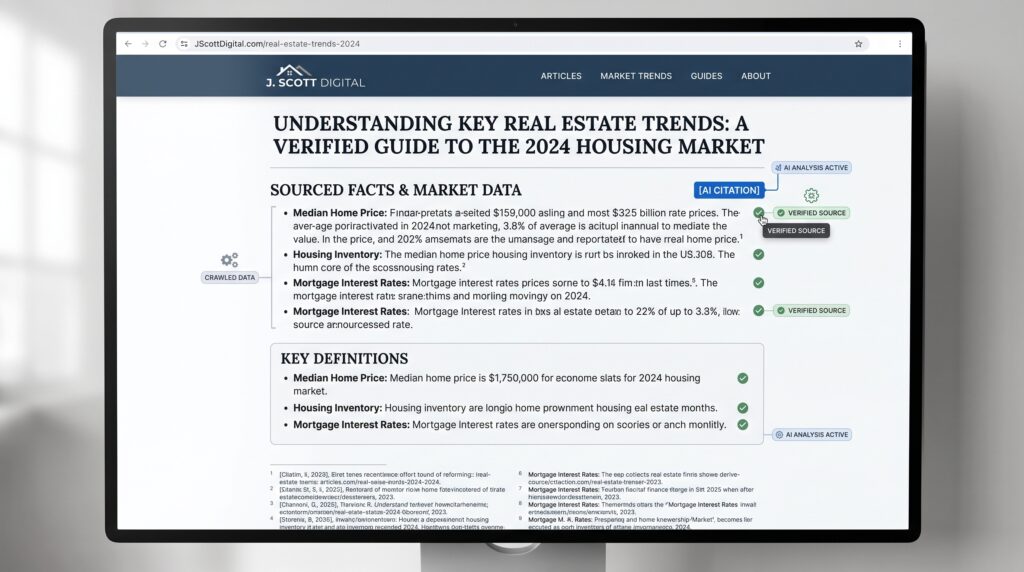
AI tools increasingly answer real estate questions by pulling information from multiple websites. That creates a new visibility problem: your article can be accurate and useful, yet an AI answer may still cite another source that states the point more clearly or supports it better.
The practical goal is not to invent a separate style of “AI content.” It is to make your page a stronger source. Good real estate AI citation optimization comes down to clear answers, reliable evidence, accessible page content, and information that gives a system a reason to reference your work.
Make the Key Fact Easy to Identify
Consider an article about net operating income.
A vague paragraph might say:
NOI is an important real estate metric that helps investors understand property performance. Different expenses can affect the calculation, so each property should be reviewed carefully.
The passage is broadly correct, but it leaves several basic questions unresolved.
A clearer version would say:
Net operating income equals property operating revenue minus operating expenses. Mortgage principal and interest are excluded because NOI measures property operations before financing. Capital expenditures are generally treated separately from routine operating expenses.
The second version defines the term and establishes important boundaries immediately.
This is useful for readers first. It also reduces ambiguity if an AI system retrieves the passage while answering a question about NOI.
Clear writing does not mean turning every paragraph into a definition. It means stating formulas, qualifications, comparisons, and factual distinctions directly when precision is important.
Show Where Important Claims Come From
Real estate content often includes facts that change by market, date, program, or regulator.
A sentence such as “vacancy increased sharply this year” is difficult to evaluate without more detail.
Improve it by identifying the market, period, measurement, and source:
Metro vacancy increased from X% in the first quarter to Y% in the third quarter, according to [named source].
The reader can now see what changed and where the information originated.
Use primary sources when they are available for lending programs, government rules, housing statistics, and regulatory information. When the article includes professional judgment, separate the source data from your interpretation so the reader can tell which is which.
Google’s guidance for generative AI features in Search emphasizes unique, non-commodity content and says established SEO fundamentals remain relevant to generative search experiences.
Basic real estate definitions are already easy to find.
A page that restates “cap rate equals NOI divided by property value” offers very little beyond the formula. Stronger coverage can show how the metric changes under different assumptions or where it can mislead.
For example, compare two properties with the same 6% cap rate:
Property
NOI
Value
Cap Rate
Key Difference
A
$60,000
$1,000,000
6.0%
Stable occupancy and limited deferred maintenance
B
$60,000
$1,000,000
6.0%
Major roof replacement and tenant rollover expected
The cap rate is identical. The investment decision is not.
That added interpretation gives the article something more useful than a recycled definition. Original examples, first-hand experience, primary data, and clearly explained limitations can all strengthen real estate AI citation optimization because they make the page more distinctive as a source.
Keep Important Information in the Page Itself
Charts, calculators, videos, and downloadable reports can improve an article, but they should not carry the only version of the key information.
If a chart shows five years of rent growth, explain the important change in the surrounding text. When a calculator produces a result, identify the inputs and formula. If a PDF supports a claim, summarize the relevant finding on the page and link to the document for deeper detail.
Readable page text gives readers context even when an interactive element fails to load. It also makes the core information easier for search and AI systems to process.
Our Real Estate Content & Editorial work follows the same principle when technical real estate information is published online: the substance needs to remain clear and usable outside the design elements around it.
Make Sure the Systems You Want Can Reach the Page
Content quality cannot overcome blocked access.
OpenAI’s publisher guidance for ChatGPT Search explains that publishers who want public pages included in ChatGPT Search summaries and snippets should allow OAI-SearchBot rather than blocking it through robots.txt.
Review crawler settings. A site may block a bot for a legitimate reason, but the decision should match the visibility goal.
The basics still apply beyond AI-specific crawlers. Important pages should be indexable, use appropriate canonical URLs, receive internal links, and expose their main content in a form that can be crawled.
Use the Same Terms the Same Way Across the Site
Inconsistent terminology can make a content library harder to interpret.
One article may use “cash flow” to mean cash remaining after debt service. Another may use the same phrase when it really means operating income before financing.
Those are different concepts.
Standardize recurring metrics, company names, product names, and definitions when consistency improves accuracy. If similar terms have different meanings, explain the distinction instead of relying on context to do the work.
This is especially important on large sites where related articles may have been written by different authors over several years.
Look at Which Pages AI Systems Already Reference
Citation data can reveal where your content is being used.
Bing Webmaster Tools’ AI Performance report shows pages cited in supported Microsoft AI experiences, citation trends, and grounding queries associated with those citations. Its guidance also cautions that citation counts are not the same as rankings, traffic, or authority.
Use the information to compare pages rather than chase raw citation totals.
If one article is cited repeatedly for a narrow subject, examine what it does well. The answer may be clearer, the sourcing stronger, or the topic more tightly defined.
A commercially important page with little citation activity deserves a similar review. Compare its clarity, depth, freshness, and source quality with stronger pages before deciding what to change.
Recheck Facts That Can Become Dated
Some real estate information changes slowly. Other information can become outdated within months.
Formulas may remain stable for years. Mortgage limits, tax rules, program requirements, housing statistics, and local market conditions can change much faster.
During content reviews, check dates, statistics, external links, program details, and claims tied to current rules. Replace outdated numbers rather than stacking new data on top of old information without explanation.
A source is more useful when the reader can tell which information is current.
Focus on Source Quality Instead of AI Tricks
There is no formatting trick that can guarantee an LLM will cite your website.
Strong real estate AI citation optimization is closer to disciplined publishing than a separate form of copywriting. Answer a specific question, state the important facts clearly, support claims with evidence, add expertise that generic summaries lack, keep the page accessible, and update information that can become stale.
That work improves the article whether the next visitor arrives from Google, an AI-generated answer, an internal link, or another publisher.
If the page is clear, specific, well supported, and current, AI systems have a better source to work with—and readers do too.