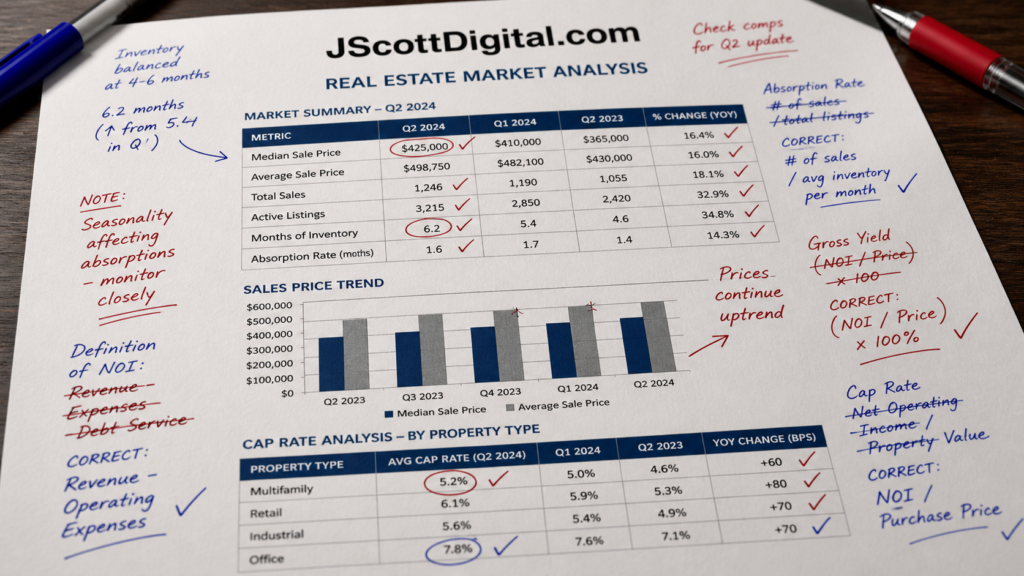
“May” becomes “will.” A metro statistic gets described as a national trend. Cap rate gets treated as cash-on-cash return because the two numbers happen to look similar in one example.
None of those problems is a grammar error. That is why real estate content fact-checking has to go beyond proofreading. You are checking whether the evidence, terminology, geography, time period, and interpretation all support what the sentence actually says.
Take one apparently polished paragraph apart and the difference becomes obvious.
Put This Paragraph Under a Fact-Check
Imagine the following appears in a draft:
“Phoenix apartment rents rose 8% last year, making multifamily a safer investment than office. A 5.2% cap rate means investors can expect a 5.2% annual cash-on-cash return. Financing the property at 75% LTV should also increase NOI because the lower equity requirement improves cash flow.”
It reads smoothly. Nearly every sentence still needs work.
Check #1: What Exactly Does the Number Measure?
“Phoenix apartment rents rose 8% last year” sounds specific enough to trust.
It is not.
You still need the source, geography, rental measure, comparison period, and methodology. “Rent” might mean asking rent, effective rent, average rent, or median rent. Phoenix could refer to the city or a metropolitan statistical area.
The same issue appears in home-price reporting. FHFA explains in its House Price Index methodology that the index measures changes in single-family home values using repeat transactions rather than simply tracking average or median sale prices.
A respected federal dataset can still be described incorrectly if the article does not match the methodology.
Check #2: Does the Fact Support the Conclusion?
Now look at “making multifamily a safer investment than office.”
Even if the 8% rent-growth figure is correct, that statistic alone cannot establish that one entire asset class is safer than another.
What does “safer” mean? Lower income volatility? Less tenant concentration? Better liquidity? Lower capital requirements?
A fact-checker has to inspect the bridge between evidence and conclusion. Real estate content often fails there because a valid number creates a false sense that everything written after it is equally supported.
Check #3: Are Similar Terms Being Treated as Identical?
“A 5.2% cap rate means investors can expect a 5.2% annual cash-on-cash return.”
The sentence is clean. The concept is not.
Cap rate relates property-level NOI to value or purchase price. Cash-on-cash return compares cash flow to the investor’s cash invested. Financing can make those two measures diverge significantly.
This is where subject-matter review earns its keep. A copy editor can improve the sentence while leaving the underlying error untouched.
Check #4: Did the Writer Change the Financial Relationship?
The last sentence claims that 75% LTV financing should increase NOI.
Debt may change cash flow to equity, but mortgage principal and interest do not normally become part of the NOI calculation. Leverage changes the capital structure; it does not automatically increase property-level NOI.
Correcting that error requires understanding the financial relationship, not simply substituting a better word.
A Source Can Be Accurate While Your Sentence Is Wrong
One of the easiest fact-checking traps is finding a credible source and assuming the work is finished.
It isn’t.
Consider the Census Bureau’s new-home sales data. Under the agency’s definitions for new residential sales, a house is counted as sold when a sales contract is signed or a deposit is accepted, including some homes that have not yet started construction. The survey does not follow the transaction through closing.
Calling that series “new-home closings” would misstate the data even though the information came directly from the Census Bureau.
Experienced real estate content fact-checking therefore asks five questions before a statistic survives editing:
What is being measured? The label used in the article should match the dataset.
Who or what is included? Single-family homes, multifamily properties, investors, tenants, mortgages, and transactions are not interchangeable populations.
Where does the figure apply? National, state, metro, county, and city data should stay in their proper geographic lane.
When was it measured? Monthly, quarterly, annual, year-over-year, and seasonally adjusted figures can tell different stories.
Has the source revised it? Preliminary or frequently revised data deserve wording that reflects that status.
The citation is only the starting evidence. Your sentence still has to represent it faithfully.
Watch the Small Words That Increase Certainty
Real estate content can become inaccurate during editing even when the original draft was defensible.
“In several Sun Belt markets” becomes “across the Sun Belt.”
“Lower-risk characteristics” becomes “safe.”
Those edits make prose sound stronger. They also make claims broader and harder to defend.
Superlatives deserve the same attention. Words such as “best,” “highest,” “lowest,” “fastest,” and “most profitable” create comparisons that require evidence.
A useful fact-check is therefore partly a certainty check: did the strength of the language move beyond the strength of the source?
Follow the Claim Backward, Not the Citation Forward
Weak verification often works like this:
Draft claim → search for something similar → add a link
That process can produce citations that look authoritative without supporting the exact statement.
Reverse the order:
Draft claim → original source → methodology → relevant passage or data point → final wording
The Duke Reporters’ Lab fact-checking criteria emphasize examining discrete claims, reaching conclusions, identifying sources transparently, and explaining methods when evaluating fact-checking organizations.
That logic works well for real estate publishing. The evidence should determine how the claim is written rather than being recruited afterward to defend wording that has already been decided.
Separate Three Types of Accuracy
“Is this accurate?” sounds like one question. In practice, an expert reviewer is checking at least three different layers.
Evidence Accuracy
Can the name, number, date, quotation, market statistic, or company fact be verified from a reliable source?
This is the easiest layer to document.
Interpretive Accuracy
Does the explanation fairly represent what the evidence allows you to conclude?
Transaction volume can fall without proving demand collapsed. Rent growth can slow while remaining positive. Higher cap rates may reflect several changing variables rather than one simple cause.
A fact can be right while the interpretation reaches too far.
Technical Accuracy
Does the terminology mean what the article says it means?
NOI is not cash flow. LTV is not loan-to-cost. Asking rent is not necessarily effective rent. Appreciation is not total return.
That layer is one reason grammar review alone cannot protect technical real estate content.
Our Real Estate Content & Editorial work combines editing with fact-checking, terminology review, financial research, and quality assurance so that a clean sentence is not mistaken for a correct one.
Keep a Fact Trail for the Next Editor
A good check should leave evidence behind.
For important statistics and claims, record the original source, source date, geography, time period, relevant table or page, and any note needed to explain the interpretation.
That record becomes useful months later when the content needs an update. The next editor can see what supported the original wording and whether the evidence has changed.
This turns real estate content fact-checking into part of maintaining an authoritative content library.
The Error You Should Fear May Read Perfectly
A broken sentence announces itself. A sophisticated factual error often does not.
The source may be credible but measure something different from the claim. Technical language can sound familiar while being used incorrectly. A real statistic may be stretched into a conclusion that the data never established.
Those are the mistakes subject-matter review is designed to catch.