How Editorial Workflows Prevent Costly Content Errors
August 17, 2026
A writer finishes an article. An editor cleans it up. Someone uploads it to WordPress, gives it one last look, and hits publish.
Simple enough.
Until someone notices that the mortgage terminology is wrong. Or a statistic came from an outdated report. Maybe a sentence about prospective tenants creates a fair housing concern. In another case, the facts are fine but the article sounds nothing like the rest of the company’s content.
None of these problems necessarily comes from careless work. More often, they happen because one person was expected to catch everything at once.
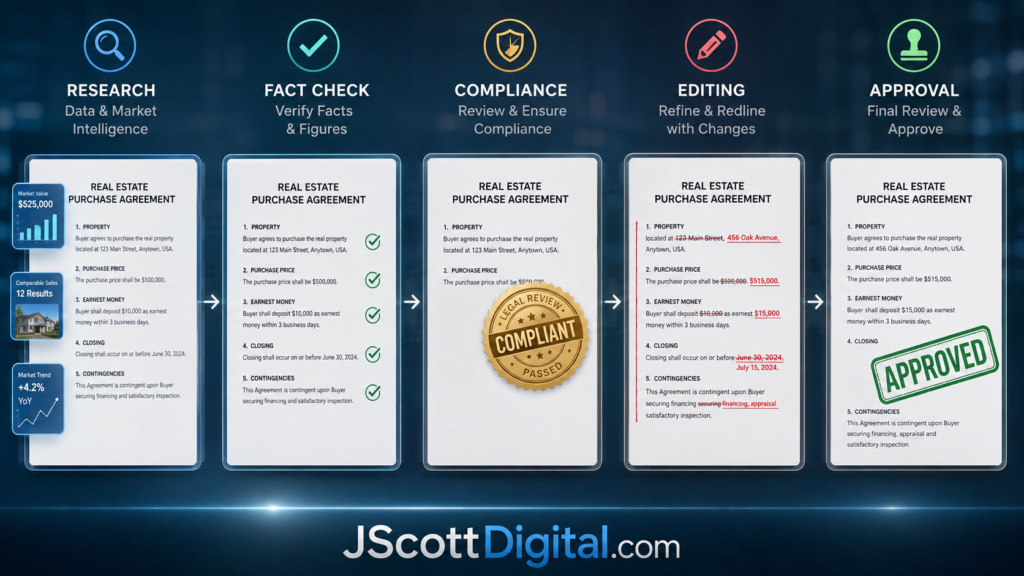
A good real estate editorial workflow takes a different approach. Instead of relying on a final proofread to find every possible problem, it gives different types of review their own place in the process.
Editing Isn’t One Job
“Send it to editing” sounds like a single step.
In practice, an editor may be looking for several very different things:
Is the information accurate?
Are the real estate terms being used correctly?
Do cited figures still match the source?
Could the wording create a regulatory or legal issue?
Does the article sound like the company?
Is the explanation easy to follow?
Are links, names, numbers, and formatting correct?
Trying to answer all of those questions during one read is difficult.
Think about how you read when you’re checking numbers. Your attention naturally moves toward dates, percentages, calculations, and sources. Read the same article for tone and you’re paying attention to rhythm, phrasing, word choice, and personality instead.
A real estate editorial workflow separates those jobs enough that each one gets real attention.
Start by Defining What the Draft Is Supposed to Do
A surprising number of content problems begin with a vague assignment.
“Write 1,200 words about multifamily investing” leaves a lot open to interpretation.
Who is reading it? What will they learn? Is the article educational or promotional? How experienced is the audience? Which claims require sourcing? Are there subjects the company doesn’t address? Which terminology does the brand normally use?
Clear assignments don’t eliminate editing. They reduce the number of problems editors have to fix later.
Get the Risk Level Right Early
Not every article needs the same amount of review.
A glossary definition for “vacancy rate” carries a different level of risk from an article discussing mortgage advertising, fair housing, securities, taxes, or legal obligations.
The subject can determine the workflow before writing begins.
For example, HUD’s overview of the Fair Housing Act makes clear that federal protections apply across housing-related activities including renting, buying, and obtaining a mortgage. HUD materials also address discriminatory statements and advertising. That makes wording around protected classes, tenant preferences, neighborhoods, and housing availability more than a stylistic issue.
A higher-risk article can therefore be flagged for an additional subject-matter or compliance review before anyone starts polishing commas.
Instead of thinking about editing as one big final review, break it into passes.
The exact sequence will vary by organization, but a practical real estate editorial workflow might move through four distinct checks.
Pass 1: Does the Real Estate Make Sense?
This is where subject-matter knowledge matters.
Suppose a writer describes cap rate as the investor’s annual cash return after mortgage payments. The sentence may be grammatically perfect, but the terminology is wrong.
Similar problems appear with:
NOI versus cash flow
Preapproval versus prequalification
Market rent versus contract rent
Operating expenses versus capital expenditures
LTV versus loan-to-cost
Gross lease versus net lease
Appreciation versus total return
A general editor may notice some of these errors. Someone familiar with real estate is more likely to catch them quickly and understand why they matter.
This first pass also looks for reasoning that doesn’t quite add up. Perhaps the article discusses improving NOI but recommends an action that only affects financing. Maybe a property-management example confuses owner expenses with tenant charges.
Those aren’t proofreading problems. They’re subject problems.
Pass 2: Can the Facts Be Defended?
Once the real estate logic holds together, the factual claims deserve their own review.
A statistic that was correct two years ago may now be outdated. Interest-rate references can age even faster. Market reports get revised, regulations change, and company information moves.
This pass focuses on questions such as:
Where did this number come from?
Is the source current enough for the claim?
Does the linked source actually say what the article says it does?
Is the geographic scope clear?
Is a national statistic being presented as though it applies to one city?
Has an estimate accidentally turned into a statement of fact?
It also helps to distinguish fact from interpretation.
“The vacancy rate increased” is a factual statement that can be checked.
“The increase suggests landlords have less pricing power” is an interpretation. It may be reasonable, but the writing needs to present it that way.
Pass 3: Is There Anything That Needs a Compliance Look?
This doesn’t mean sending every blog post to an attorney.
It means recognizing when content moves into an area where normal editorial review isn’t enough.
Mortgage advertising provides a useful example. CFPB’s Regulation Z advertising requirements contain specific rules governing the way certain credit terms can be advertised. In an enforcement matter involving mortgage advertisements, CFPB even required an advertising compliance official to review mortgage advertising templates before use.
The takeaway for a content team is straightforward: some subjects deserve a specialist checkpoint.
Depending on what your company publishes, that might include content involving:
Lending terms
Fair housing
Investment performance
Tax treatment
Legal obligations
Insurance coverage
Regulatory requirements
Promotional claims
An editor can flag the concern without pretending to provide legal advice. The workflow simply routes the draft to someone qualified to make the next call.
Pass 4: Does It Sound Like Us?
By this point, the article may be accurate and technically solid.
It can still feel wrong.
Maybe one writer calls people “residents” while another uses “tenants.” One article says “multifamily,” another uses “multi-family,” and a third switches between both. A company that normally writes in a straightforward, conversational voice suddenly publishes something packed with corporate jargon.
Readers notice inconsistency even when they can’t explain exactly what’s bothering them.
A brand-and-language pass looks for:
Preferred terminology
Tone of voice
Capitalization
Company and product names
Acronyms
Formatting conventions
Repeated phrases
Unnecessary jargon
Claims that sound stronger than the evidence supports
This isn’t about making every writer sound identical. It’s about making the publication feel like it comes from the same organization.
That combination of subject-matter review, fact-checking, brand voice, and editing is also central to our Real Estate Content & Editorial work.
Keep the Final QA Pass Boring
The last review shouldn’t be where someone discovers that half the article needs to be rewritten.
At this stage, boring is good.
The final check can focus on the details that are easy to miss while working on bigger issues:
Headings are in the right order
Links work
Names are spelled correctly
Images match the article
ALT text is present
Metadata is complete
Numbers didn’t change during editing
Formatting works on desktop and mobile
The correct version was uploaded
One more useful question belongs here:
Did the edits create a new error?
It happens more often than you’d expect. A sentence gets shortened and loses an important qualifier. Two paragraphs are combined and a statistic becomes attached to the wrong claim. Someone updates a number but forgets to change the accompanying percentage.
Final QA catches the damage editing can occasionally cause.
Avoid Building a Workflow With Too Many People
More reviewers don’t automatically produce better content.
A draft that passes through eight people can become slower without becoming more accurate. It may also collect contradictory edits and lose its original voice.
The better approach is to give each reviewer a clear purpose.
Your subject-matter reviewer doesn’t need to rewrite the introduction because they prefer a different style. The copy editor doesn’t need to second-guess an approved compliance decision. A final QA reviewer isn’t there to reopen the article’s entire argument.
Clear ownership keeps the process moving.
For lower-risk content, one experienced person may handle several review stages. Higher-risk pieces can bring in specialists only where they’re needed.
Fix the Process When the Same Error Keeps Returning
An editorial workflow becomes more valuable over time because mistakes leave clues.
If writers repeatedly misuse the same terminology, add it to the style guide.
When outdated statistics keep slipping through, require source dates in the draft.
If promotional claims routinely get softened during compliance review, tighten the assignment instructions before writing begins.
Repeated corrections usually point to a process problem, not just a writer problem.
Tracking a few categories can help:
Factual errors — incorrect numbers, dates, names, or claims Terminology errors — incorrect or inconsistent industry language Compliance flags — wording requiring specialist review Brand issues — tone, naming, formatting, or style inconsistencies Production errors — broken links, missing metadata, wrong images, formatting problems
After several months, patterns become easier to see.
Make Accuracy Part of the Process
Nobody wants to add unnecessary steps between a draft and the publish button.
The goal isn’t bureaucracy. It’s catching the right problem at the right moment.
A strong real estate editorial workflow lets the subject-matter review focus on real estate, the fact-check focus on evidence, the compliance review focus on higher-risk claims, and the brand edit focus on how the company communicates. Final QA then handles the small details without carrying the burden of everything that came before.
That division of labor makes content easier to manage as publishing volume grows.
More importantly, it reduces the chance that one overlooked sentence becomes the part of the article everyone remembers.