How Resource Libraries Turn Traffic Into Trust
Someone finds one of your articles through search, gets the answer they need, and leaves.
That isn’t a bad outcome. You helped the reader, earned a visit, and introduced your brand.
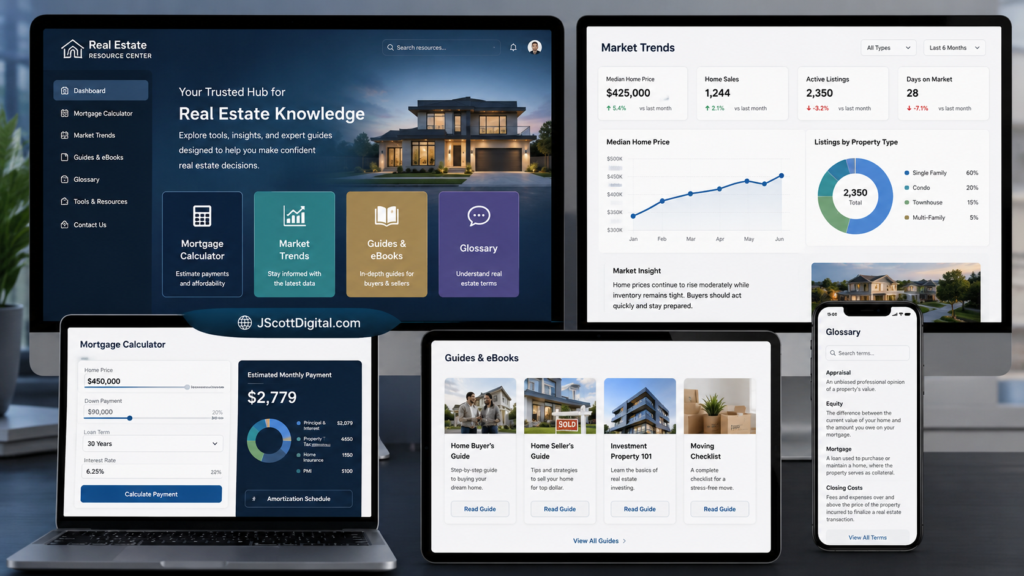
But compare that with what happens when the same person discovers a useful article and then notices a calculator, a detailed guide, a glossary, and several related reports. Instead of seeing one good page, they begin to see a body of work.
That shift matters.
A well-built real estate resource library gives visitors somewhere to go after the first answer. More importantly, it shows that your expertise runs deeper than the page that happened to bring them in.
One Useful Page Gets Attention. A Library Shows Depth.
Individual articles have an important job. They answer specific questions.
A resource library does something broader: it helps readers understand how much useful information sits behind that first answer.
Think about a rental property owner searching for an explanation of cash-on-cash return. One clear article may solve the immediate question. Now suppose the same site also offers an investment calculator, a glossary of real estate finance terms, an underwriting guide, and a report discussing how financing assumptions affect returns.
The reader no longer sees a website that happened to publish something about cash-on-cash return.
They see a useful place to return to.
That idea fits naturally with the Content Marketing Institute’s definition of content marketing, which emphasizes valuable, relevant, and consistent information rather than simply promoting products or services. A resource library puts that principle into practice by making usefulness part of the website itself.
Give Different Resources Different Jobs
A common mistake is treating every educational asset as another blog post.
Some questions need 800 words. Others are better answered with a definition, calculation, downloadable reference, or deeper research piece.
That variety makes the library more useful because readers don’t always arrive with the same problem or the same amount of time.
| Resource | Best job |
|---|---|
| Guides | Explain a process or complex topic in depth |
| Glossaries | Clarify terminology quickly |
| Calculators | Help readers apply information to their own numbers |
| Reports | Provide analysis, research, or market context |
| Checklists | Turn a complicated process into manageable steps |
| Templates | Help readers put information into practice |
The strongest library isn’t necessarily the one with the most resources. It’s the one where each format has a reason to exist.
Guides Help Readers Go Deeper
A good guide takes a subject that is too broad for a quick article and gives it enough room.
That could mean explaining rental property analysis from income through financing, walking through the stages of a commercial lease review, or showing how investors think about market cycles.
Depth is useful, but structure matters just as much. Long guides need descriptive headings, logical sections, supporting links, and a clear path for readers who only need one part of the answer.
Glossaries Remove Friction
Real estate has no shortage of terminology.
Cap rate. DSCR. Loss to lease. CAM. NOI. Recourse. LTV. Absorption. Tenant improvements.
Experienced professionals may use these terms every day. Someone researching a new property type or investment strategy may not.
A glossary gives that reader a quick answer without forcing them to leave the site. It also creates natural opportunities to connect definitions with more detailed articles, guides, and tools.
The result is less friction and a better path through your content.
Calculators Turn Reading Into Participation
A calculator asks the reader to do something with the information.
Instead of simply reading how loan-to-value works, they can enter a property value and loan amount. A cash-flow calculator lets them test assumptions. Rent or operating-expense tools can help turn an abstract concept into something connected to an actual property.
That doesn’t mean every formula deserves its own calculator. A useful tool solves a recurring problem and produces a result the reader can understand.
When it does, the page becomes more than something to read once.
Reports Give You Room to Interpret
Reports work especially well when your value comes from analysis rather than basic education.
You might examine transaction activity, rent movements, property-management costs, lending conditions, or changes affecting a particular asset class.
The numbers matter, but the interpretation is usually what makes the report worth reading. Readers can find statistics in many places. A strong report helps them understand why those figures matter and how they fit together.
Build Around Questions, Not File Types
It’s easy to organize a resource center around internal categories:
Guides. Calculators. Reports. Downloads.
That structure may make sense to your team, but your reader is probably thinking about a problem instead.
Someone researching rental-property finances may want a definition of NOI, then a calculator, followed by an expense guide. Another visitor exploring foreclosure investing may move from terminology to financing to renovation risk.
Organizing related resources around subjects makes those paths easier to follow.
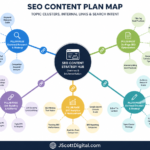
HubSpot’s current topic-cluster model uses a similar principle: broad pillar content connects to more focused pages, while internal links help readers and search systems understand how the material fits together. HubSpot also notes that this kind of structure shortens the path between a broad question and a more specific answer.
For a real estate resource library, a topic-based structure might look something like this:
Rental Property Finance
- NOI glossary definition
- Cap-rate guide
- Cash-on-cash return calculator
- Financing terminology
- Expense analysis article
- Investment-analysis report
Property Management
- Tenant-screening guide
- Management fee glossary
- Operating-cost checklist
- Rental performance calculator
- Market-downturn report
Each resource stands on its own, but together they create something more useful.
Help Readers Discover the Next Question
Good internal linking isn’t about adding three random links at the bottom of every page.
The better opportunity appears when you anticipate what the reader is likely to wonder next.
After explaining cap rates, a natural next question might involve NOI. A financing guide may lead naturally to a DSCR calculator. Someone reading a report about rental-market conditions might benefit from a guide on evaluating property-level assumptions.
Those connections keep the experience moving.
They also prevent strong resources from becoming buried several clicks deep where visitors rarely find them.
A real estate resource library should feel less like a storage room and more like a well-organized reference desk.
Evergreen Resources Can Keep Working
News and market commentary have a short natural life. That’s fine when timeliness is the point.
Other resources answer questions that remain relevant for years.
The U.S. Chamber of Commerce describes evergreen content as material that continues addressing persistent questions over a long period. It specifically identifies formats such as frequently asked questions and glossaries as strong candidates, while noting that evergreen material can continue attracting traffic and helping establish authority.
Real estate offers plenty of evergreen subjects:
- How NOI is calculated
- What a cap rate means
- How property-management fees work
- What DSCR measures
- How security deposits are handled
- What loan-to-value represents
- How investors compare property returns
The core question may remain stable even when examples, regulations, rates, or market conditions change.
That’s why evergreen doesn’t mean “publish it and forget it.”
A Resource Library Needs Maintenance
The bigger your library becomes, the easier it is for yesterday’s useful resource to become today’s liability.
An old report may contain stale numbers. A calculator may rely on assumptions that no longer make sense. Links break. Definitions evolve. A guide written five years ago might still rank even though parts of it need revision.
Maintenance is part of the product.
A practical review might look at:
- Accuracy
- Publication and update dates
- Broken links
- Outdated screenshots
- Old statistics
- Duplicate resources
- Search performance
- Internal links
- Calls to action
- Resources that no longer match your current expertise
The U.S. Chamber’s evergreen-content guidance makes the same distinction: the underlying topic can remain useful while the content covering it still needs periodic updating.
Use Your Best Resources to Show What You Know
A resource library also gives you a quieter way to demonstrate expertise.
Instead of saying, “We understand real estate investing,” you can publish a detailed investment guide.
Rather than claiming expertise in property management, you can provide tools, books, terminology, and analysis that make that knowledge visible.
Our Books & Resources collection follows that same idea by bringing real estate books and practical educational resources together around subjects such as property management and investment analysis.
Proof tends to be more persuasive when the reader discovers it through useful work rather than a marketing claim.
Give Traffic Somewhere Worth Staying
Traffic is useful, but a pageview by itself doesn’t tell you much about the relationship you’ve built with the visitor.
A reader who finds one article may remember the answer.
Someone who finds an article, uses a calculator, reads a related guide, and later returns for another resource has experienced something different. Your website has started becoming a reference point.
That’s the larger value of a real estate resource library.
Guides create depth. Glossaries remove confusion. Calculators make information practical. Reports give you room to add interpretation. Thoughtful organization connects all of them.
Over time, the library becomes more than a collection of pages built to attract search traffic.
It becomes a reason to trust the site that published them.