Writing content that ranks well on Google is not about forcing a keyword into every paragraph. It is about understanding what the reader is trying to solve, organizing the page around that need, and making each on-page element clear enough for both people and search engines.
You can have a well-written article that never ranks because it targets the wrong keyword. You can also have a heavily optimized article that fails because it does not actually help the reader. Strong SEO content sits between those two mistakes. It is researched before it is written, structured before it is polished, and optimized before it is published.
For real estate businesses, investors, property management firms, and professional service providers, this matters because weak content does more than miss traffic. It can make your expertise appear shallow. When you write SEO content that ranks, you are not just chasing visibility. You are building a page that can support trust, leads, and long-term authority.
Start With Search Intent Before You Write
Before you choose a title or draft an outline, ask one question: what does the searcher want to accomplish?
A keyword is only the surface. The intent behind it is what determines the article you should write. Someone searching “property management software pricing” probably wants comparison, cost ranges, and buying considerations. Someone searching “how to screen tenants” wants a practical process. Someone searching “real estate content writer” may be evaluating whether to hire a specialist.
Google’s own helpful content guidance emphasizes content created for people rather than content created mainly to manipulate rankings. That distinction should shape your entire approach. You are not writing for a machine first. You are writing for a reader whose problem is specific enough to type into search.
Identify the job the keyword is doing
A useful SEO brief should separate three things:
The topic is the broad subject, such as real estate content marketing.
The primary keyword is the phrase you want the page to compete for, such as “write SEO content that ranks.”
The search intent is the reader’s expected outcome, such as learning a repeatable content-writing process.
When those three pieces align, the page has a clear purpose. When they do not, the article usually becomes unfocused. That is how you end up with a post that begins as a keyword research guide, turns into a copywriting article, and ends with a generic marketing pitch.
Build a Keyword Map Instead of a Keyword List
Keyword research is not simply collecting phrases with search volume. It is deciding which phrases belong on one page, which deserve separate pages, and which should be ignored.
A good keyword map gives your article boundaries. It helps you avoid writing one bloated page that tries to rank for everything. The Ahrefs keyword research guide is useful here because it frames keyword research as a process of evaluating related terms, traffic potential, and intent rather than picking phrases in isolation.
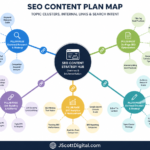
For a blog post on how to write SEO content that ranks, your keyword map might look like this:
Primary phrase: write SEO content that ranks
Secondary phrases: SEO content writing, keyword research for blog posts, on-page SEO, meta descriptions, search intent
Supporting concepts: title tags, H1 and H2 structure, internal links, featured image ALT text, content refreshes
This kind of map keeps the article focused. You are not stuffing every phrase into the body copy. You are using the secondary terms to decide which sections the reader expects to see.
Choose one primary phrase
Each post should have one primary target. That does not mean the page can only rank for one query. It means the article needs one central promise.
If the phrase is too broad, the article becomes vague. If it is too narrow, there may not be enough demand or depth to support a full post. The phrase “SEO” is too broad for most business blogs. The phrase “how to write SEO content that ranks” is more workable because it suggests a specific reader problem and a practical outcome.
Your outline is where SEO strategy becomes reader experience.
A weak outline follows what the writer wants to say. A strong outline follows what the reader needs to understand next. That difference is visible in the headings.
For example, an article with sections like “Keyword Research,” “Optimization,” and “Conclusion” is technically organized, but it is not especially useful. The reader still has to figure out what to do. Stronger headings guide action: “Choose the Keyword Before You Choose the Title,” “Use Subtopics to Build the Article Structure,” and “Write the Meta Description After the Draft Is Complete.”
Use H2s for the major decisions
Your H2 headers should identify the main steps in the article. For this topic, those steps are intent, keyword mapping, outline structure, writing, optimization, and review.
Your H3 headers should clarify smaller tasks inside each step. That gives the article a logical hierarchy, and it helps the reader scan without losing the thread.
This matters because many readers do not move through a blog post from top to bottom. They scan, pause, backtrack, and look for the section that answers their immediate question. Your structure should make that easy.
Write Naturally Before You Optimize Mechanically
Once the outline is clear, write the article for the reader first. Do not stop every few sentences to count keyword placements. You can optimize later.
The first draft should answer the question fully. Explain the concept, show how it works, and give enough practical detail that the reader can act. If you are writing for a technical or high-trust industry such as real estate, finance, insurance, lending, or property management, accuracy also matters. A polished article with thin subject-matter knowledge can still damage credibility.
That is one reason J. Scott Digital positions real estate content and editorial services around industry knowledge, editing, fact-checking, and content strategy rather than generic writing alone. In specialized fields, ranking is only useful if the content also sounds credible to the people you want to reach.
Place the keyword where it helps
After the draft is written, review the important on-page locations:
Use the primary keyword or a close variation in the H1.
Include it naturally in the introduction.
Use related phrases in H2s or H3s where they genuinely fit.
Add the phrase or a variation to the meta description.
Use descriptive anchor text for internal links.
Use image ALT text that describes the image and supports the page topic when relevant.
The goal is clarity, not repetition. If the sentence sounds strange because of the keyword, rewrite the sentence.
On-page SEO gives Google signals about what the page covers. Those signals include the title, headings, URL, body copy, image descriptions, internal links, and meta description.
A practical on-page SEO checklist can help you verify that the basic page elements are in place before publication. The point is not to turn SEO into a mechanical checklist. The point is to avoid missing simple items that affect how the page is interpreted and displayed.
Write the meta description last
Your meta description should summarize the page in plain language. Keep it under roughly 150 to 160 characters when possible, include the primary phrase if it fits naturally, and give the reader a reason to click.
Do not write a vague description such as:
“Learn everything you need to know about SEO content.”
A stronger version is:
“Learn how to write SEO content that ranks with keyword research, stronger structure, meta descriptions, and on-page optimization.”
That version tells the reader what the article covers and reinforces the page’s target phrase without sounding forced.
Use internal links with intent
Internal links should help the reader continue in a useful direction. Link to a related service page, guide, glossary, case study, tool, or resource only when it naturally extends the article.
Do not use generic anchor text like “click here.” Use descriptive anchor text that tells the reader what they will find. This helps usability and gives search engines more context about the linked page.
Review the Article Like an Editor Before Publishing
Before you publish, run a final review that covers both SEO and credibility.
Ask whether the article answers the searcher’s question directly. Confirm that the title, H1, and meta description match the actual content. Check whether each H2 introduces a meaningful section rather than acting as decoration. Look for unsupported claims, thin explanations, repeated phrases, and generic advice that could appear on any website.
Then look at the article from the reader’s perspective. Is the introduction too slow? Are the examples specific enough? Does the article provide a clear process? Is the ending useful, or does it simply repeat the introduction?
This is where many SEO articles fail. They are optimized at the surface level but weak at the editorial level. They include the keyword, but they do not demonstrate judgment.
Make the Page Worth Ranking
The most reliable way to write SEO content that ranks is to stop treating ranking as the only objective. A page earns its opportunity when it is specific, useful, well-structured, and credible.
Keyword research helps you choose the right target. Search intent helps you understand the reader’s real goal. On-page optimization helps Google interpret the page. Editing turns the article from a draft into a professional asset.
When those pieces work together, your content has a stronger chance to rank. More importantly, it has a stronger chance to convert the right reader after they arrive.