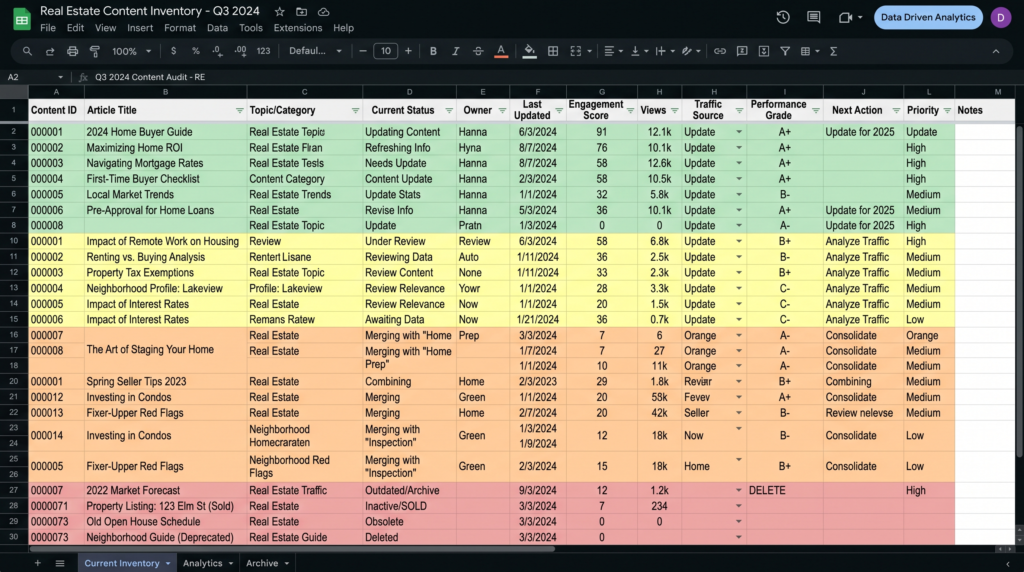
A real estate content audit helps you determine whether the information on your website is accurate, useful, discoverable, authoritative, and aligned with your current strategy.
It isn’t simply an exercise in identifying articles with low traffic. A page may attract few visitors but still support an important service, explain a technical concept, or complete a reader’s decision path. Conversely, a high-traffic article may expose your brand to unnecessary risk if it contains outdated statistics or questionable advice.
A useful real estate content audit evaluates each page from several perspectives. You need to examine accuracy, relevance, duplication, performance, and strategic value before deciding what should happen next.
Begin With a Complete Content Inventory
You can’t audit a library until you know what it contains.
Start by exporting or crawling every indexable URL on your website. Include more than blog posts. Federal guidance on digital content recognizes that website content includes articles, images, forms, videos, data feeds, and other elements that communicate meaning. Your inventory may therefore include calculators, glossaries, market reports, landing pages, downloadable guides, author profiles, and category archives.
Create a spreadsheet with one row for each URL. At minimum, record:
Page title and URL
Content type
Primary topic
Intended audience
Author or reviewer
Original publication date
Most recent review date
Target keyword or search intent
Organic traffic and impressions
Internal and external links
Conversion purpose
Recommended action
Person responsible for the update
Don’t begin making decisions while you are still building the inventory. First establish the full scope of the library. Otherwise, you may update one article before discovering that three other pages address the same subject more effectively.
A real estate content audit works best when you review each page against consistent criteria. Avoid assigning an action based on one metric alone.
1. Accuracy
Accuracy should be your first test because real estate information can affect financial and operational decisions.
Review each page for:
Outdated market statistics
Expired program terms
Incorrect formulas
Unsupported performance claims
Obsolete financing information
Misused legal or industry terminology
Broken or outdated sources
Recommendations presented without material qualifications
Pay particular attention to pages discussing taxes, lending, insurance, regulations, investment returns, and landlord-tenant practices. Even when an article is intended as general education, it should distinguish broad principles from matters that vary by jurisdiction, lender, property type, or individual transaction.
Give every substantial page an identified content owner. That person doesn’t necessarily have to rewrite it, but someone should be responsible for determining when another review is required.
2. Relevance
A page can be factually correct and still no longer belong in your library.
Ask whether the content continues to serve your present audience and business model. A website may accumulate articles written for services that are no longer offered, audiences that are no longer targeted, or editorial strategies that have since changed.
Use questions such as:
Does this page support one of your current subject areas?
Is the reader likely to need this information today?
Does the article address the search intent suggested by its title?
Is the depth appropriate for the intended audience?
Does it reinforce or distract from your website’s positioning?
Is the call to action still relevant?
Avoid retaining a page simply because it was expensive to produce. Past production cost doesn’t establish current value.
3. Duplication and Topic Overlap
Duplication often develops gradually. One writer publishes a guide to rental property cash flow, another creates a cash-flow calculation article, and a third explains why rental properties lose money. Each page may contain useful material, but all three may compete for similar searches or repeat the same introductory information.
Group URLs by topic and compare:
Search intent
Target keyword
Core question
Examples and calculations
Audience level
Conversion purpose
Technical duplicates and editorial overlap are related but different problems. Technical duplicates may present essentially the same page through multiple URLs. Google’s canonical URL guidance explains several methods for identifying a preferred URL when duplicate or very similar versions exist.
Editorial overlap usually requires judgment. You may need to combine two articles, reposition one for a different audience, or create a stronger central guide supported by narrower subtopics.
4. Performance
Performance data helps you understand how readers find and use your content, but it shouldn’t dictate every decision.
The Search Console Performance report allows you to review clicks, impressions, click-through rate, search position, queries, and individual pages over selected periods. Compare at least two meaningful time ranges so that you can identify declining, improving, or seasonal patterns rather than relying on a single snapshot.
Review more than organic traffic. Depending on the page’s purpose, useful indicators may include:
Search impressions
Relevant keyword visibility
Backlinks
Engaged sessions
Newsletter subscriptions
Form submissions
Downloads
Assisted conversions
Internal navigation to service or resource pages
A page with high impressions and a low click-through rate may need a stronger title and meta description. A page that attracts traffic but produces immediate exits may not satisfy the reader’s question. A technically strong page with few internal links may simply be difficult to discover.
5. Strategic Value
Strategic value is the dimension most automated audits overlook.
Some content deserves to remain even when its measurable traffic is modest. It may demonstrate expertise, support a sales discussion, complete a topic cluster, answer a recurring client question, or provide essential context for another resource.
For example, on a specialized publishing asset such as Foreclosure Flips, a detailed explanation of foreclosure financing may be strategically important even if a broader homebuying article generates more traffic. The narrower page directly supports the website’s subject focus and the information needs of its intended audience.
Ask what would be lost if the page disappeared. If removing it would leave an important reader question unanswered, the page may need improvement rather than deletion.
After evaluating the five dimensions, place each URL into an action category.
Keep
The page is accurate, useful, strategically relevant, and performing adequately. Minor proofreading or metadata improvements may still be appropriate.
Refresh
The article has a sound purpose but contains outdated statistics, examples, links, screenshots, or terminology. Preserve the URL and improve the existing content.
Expand
The page addresses a valuable topic but doesn’t answer the question thoroughly enough. Add examples, calculations, decision criteria, definitions, or supporting evidence.
Merge
Two or more pages serve substantially the same intent. Consolidate their strongest material into one primary resource and redirect the weaker URLs where appropriate.
Reposition
The page contains useful information but targets the wrong keyword, audience, or stage of the reader journey. Rewrite the title, introduction, structure, and calls to action around a clearer purpose.
Retire
The content is inaccurate, irrelevant, redundant, or incapable of being improved economically. Before removing it, check for inbound links, referral traffic, internal links, and a logical redirect destination.
Don’t treat “retire” as the default response to low traffic. Deleting pages without examining their broader value can remove useful information and create broken navigation paths.
Use a Simple Real Estate Content Audit Score
A scoring system can make decisions more consistent when multiple people are involved.
Give each page a score from one to five for:
Accuracy
Audience relevance
Originality
Performance
Strategic value
A page with high strategic value but low performance may be an optimization opportunity. A high-performing page with a low accuracy score should receive urgent expert review. A page scoring poorly in every category is a strong candidate for consolidation or retirement.
You can also weight the categories. For a technical real estate website, accuracy and strategic value may deserve more weight than raw traffic. For a media property funded by advertising, audience reach and engagement may carry greater importance.
The scoring system isn’t intended to replace judgment. It helps you identify where judgment should be applied first.
Prioritize Risk Before Cosmetic Improvement
Once the audit is complete, don’t work through the spreadsheet alphabetically. Organize updates by risk and potential impact.
Start with pages that are both highly visible and potentially inaccurate. These may include high-traffic investment guides, financing articles, regulatory discussions, and calculators.
Next, address pages with strong impressions or established backlinks that could perform better after updating. Then consolidate competing articles and repair internal linking. Lower-risk cosmetic tasks, such as minor formatting inconsistencies, can follow.
Your prioritized workflow might look like this:
Correct high-risk factual issues.
Refresh valuable pages with declining performance.
Merge overlapping content.
strengthen internal topic connections.
Improve titles, descriptions, and calls to action.
Retire obsolete pages and repair affected links.
This order protects credibility before focusing on incremental traffic gains.
Turn the Audit Into an Operating Discipline
A real estate content audit shouldn’t be a one-time cleanup project.
Assign review intervals according to the type and risk of the content. Market reports may require frequent attention, while a stable glossary definition may need only periodic verification. Record review dates, owners, sources, and required actions directly in your content-management process.
You should also use the findings to improve future publishing. If the audit reveals repeated articles, unclear ownership, inconsistent terminology, or unverified statistics, the underlying problem may be your editorial workflow rather than the individual pages.
A well-run audit gives you more than a cleaner website. It shows which subjects you genuinely own, where your expertise is visible, and which resources deserve further investment. By evaluating accuracy, relevance, duplication, performance, and strategic value together, you can strengthen the entire content library without confusing volume with authority.