Why Real Estate Content Fails the Credibility Test
July 3, 2026
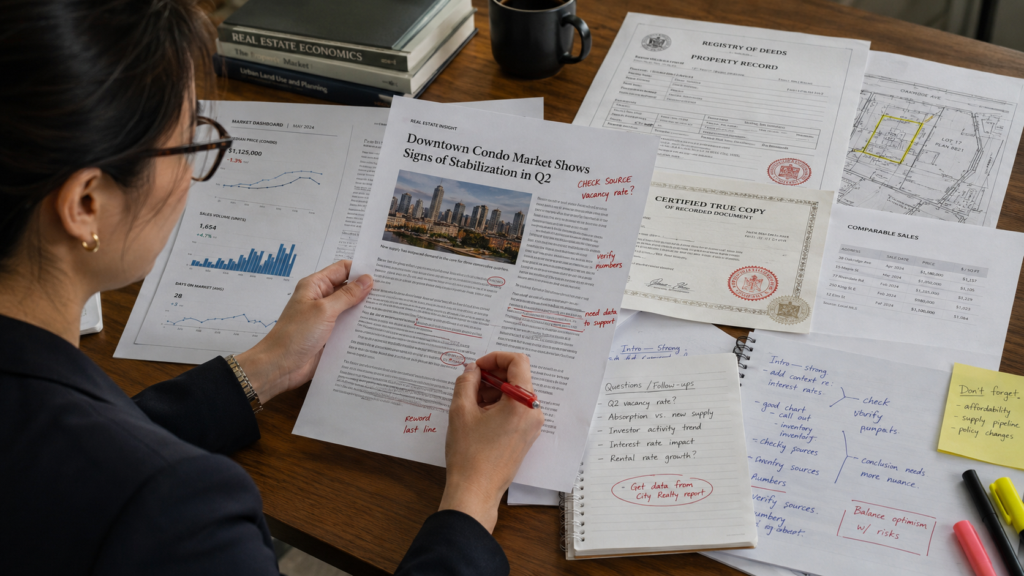
Real estate content can be polished, optimized, and easy to read—and still fail the credibility test.
The problem is rarely limited to spelling or grammar. Credibility breaks down when an article uses technical terms incorrectly, presents assumptions as facts, relies on outdated statistics, overlooks market cycles, or makes investment concepts sound simpler and more certain than they are.
Your reader may not identify every specific error. However, experienced investors, property managers, lenders, brokers, and other industry professionals can usually tell when something is wrong. Once they question one claim, they may begin questioning the rest of the page.
Real estate content credibility and authority depends on more than good writing. It requires accurate research, disciplined editing, and review by someone who understands how the industry works.
Credibility Is More Than a Writing Issue
A generalist writer can produce clear sentences. That doesn’t necessarily mean the underlying explanation is correct.
Real estate combines legal concepts, financial calculations, operational procedures, market data, and terminology that can change by property type or context. Consider the differences between:
Gross rent and effective gross income
Capital expenditures and operating expenses
Market value and assessed value
A broker price opinion and a formal appraisal
Cash flow and taxable income
Prequalification and loan approval
These distinctions aren’t cosmetic. Using the wrong term can change the meaning of an entire paragraph.
Google’s guidance for creating helpful, reliable, people-first content asks whether a page uses clear sourcing, demonstrates expertise, and gives readers reasons to trust the author or publisher. Those signals matter because a credible article shows how its conclusions were reached rather than asking readers to accept unsupported statements.
Statements such as “home prices always rise over time” or “multifamily properties are recession-proof” may sound persuasive, but they don’t survive serious review.
Market performance depends on location, asset class, financing, operating conditions, supply, demand, and the period being measured. Even a broadly reasonable observation can become misleading when it is presented as a universal rule.
Before publishing a market claim, ask:
What data supports it?
What period does the data cover?
Is the source national, regional, or local?
Does the conclusion apply to every property type?
Have recent conditions changed the analysis?
When a claim cannot be substantiated, qualify it, replace it, or remove it.
Imprecise Industry Terminology
Real estate content often loses credibility one small word at a time.
A writer may use “revenue” when the correct term is “net operating income.” A renovation article may classify a roof replacement as routine maintenance. A financing guide may treat interest rate and annual percentage rate as interchangeable.
Each mistake may seem minor in isolation. Together, they reveal that the article wasn’t reviewed by someone with subject-matter knowledge.
Create an editorial glossary for frequently used terms. Define how your organization uses capitalization, abbreviations, property classifications, financial metrics, and industry-specific language. Then apply those standards consistently across every page.
Missing Assumptions and Limitations
Numbers can be technically correct and still create a false impression.
Suppose an article states that a rental property produces a 10% cash-on-cash return. That figure means little unless the reader knows what was included in the calculation. Did the analysis account for vacancy, management, reserves, closing costs, financing fees, or immediate repairs?
Credible content makes material assumptions visible. You don’t need to burden every article with a complete underwriting model, but you should explain what the calculation includes and what could change the result.
This principle also applies to projections, forecasts, and comparative claims. Use phrases such as “based on the stated assumptions,” “in this example,” or “results will depend on financing and operating performance” when appropriate.
Promotion Disguised as Education
Content becomes less trustworthy when an educational article quietly turns into a sales pitch.
A lender may publish a financing guide that ignores the disadvantages of its preferred loan product. A property-management company may describe professional management as the only practical option. An investment sponsor may emphasize potential distributions without giving comparable attention to risk.
The Federal Trade Commission’s truth-in-advertising guidance states that promotional claims must be truthful, non-deceptive, and supported by evidence. This becomes especially relevant when articles contain performance claims, endorsements, comparisons, or sponsored recommendations.
You can advocate for a service or strategy without weakening trust. Clearly separate education from promotion, disclose material relationships, and acknowledge meaningful limitations.
Exaggeration and Omitted Facts
The temptation to simplify content can lead to overstatement.
For REALTORS®, the National Association of REALTORS® addresses this directly in Article 2 of its Code of Ethics, which requires members to avoid exaggeration, misrepresentation, or concealment of pertinent facts concerning a property or transaction.
Not every real estate writer is subject to that code, but the underlying editorial principle is broadly useful: don’t remove so much context that the remaining statement becomes misleading.
“Investors can buy property with no money down” may be possible in a narrowly structured transaction. Presenting it as a routine, universally available strategy is another matter.
Use a Practical Real Estate Content Credibility Test
Before approving an article, review it from the perspective of a skeptical reader.
Ask these seven questions:
Are the principal factual claims supported by reliable sources?
Are technical terms used correctly and consistently?
Are calculations reproducible from the information provided?
Are assumptions, risks, and material limitations visible?
Does the article distinguish facts from opinions or forecasts?
Could a promotional statement create a misleading impression?
Would an experienced real estate professional consider the explanation accurate?
The final question is particularly important. A copy editor may improve grammar and flow without recognizing that a capitalization rate has been calculated incorrectly or that a lease concept has been oversimplified.
What Expert Review Adds
Expert review doesn’t mean making every article more technical. It means identifying the level of explanation your reader needs and ensuring that the simplified version remains accurate.
Confusion between residential and commercial practices
Property-type distinctions that the writer overlooked
Claims that require qualification or additional sourcing
Contradictions between related articles
Expert review is also valuable when maintaining a large content library. A specialized platform such as Basic Property Management may cover connected topics across guides, glossaries, tools, and educational articles. Definitions and recommendations must remain consistent from one resource to another.
That is why effective real estate content and editorial review should combine writing quality, fact-checking, terminology review, brand consistency, and practical industry knowledge. This practitioner-led approach is central to J. Scott Digital’s content strategy.
Make Every Claim Survive Review
Real estate content credibility is built through dozens of editorial decisions that readers may never see.
You strengthen trust when you verify statistics, qualify projections, define technical language, disclose assumptions, and remove claims that cannot be supported. You strengthen it further when someone with relevant industry experience reviews the article before publication.
The objective isn’t to eliminate every opinion or make every page sound like a technical manual. It is to ensure that your content remains useful, accurate, and defensible after an informed reader begins asking questions.
That is the credibility test—and every published article should be able to pass it.