Building Lead Generation Into a Real Estate Website
August 28, 2026
A useful real estate article can attract exactly the person you want to reach and still generate nothing beyond a pageview.
Sometimes the site asks for too much before the reader has received anything useful. In other cases, the content does its job perfectly but gives an interested visitor nowhere logical to go next.
The better approach to real estate website lead generation is to make the next step feel like part of the reader’s journey rather than a detour into your sales process. Educational content can stay educational while still creating clear paths toward deeper resources, services, or an inquiry when the timing makes sense.
Map the Website Before You Add Another CTA
Lead generation is often discussed as a collection of forms, buttons, popups, and landing pages. That view starts too late.
First decide what each page is supposed to help the visitor accomplish. A glossary definition serves someone differently from a case study, and a calculator has a different job from a service page.
Page type
Reader’s likely goal
Sensible next step
Blog article
Solve a specific problem
Related article, guide, or tool
Glossary
Understand a term
Deeper explanation or example
Calculator
Apply numbers to a situation
Guide, report, or relevant service
Case study
Evaluate credibility
Expertise or service page
Resource page
Learn in more depth
Download, newsletter, or related resource
Service page
Evaluate professional help
Project inquiry
Notice what isn’t on every row: “Contact us.”
Someone looking up the meaning of DSCR has not necessarily shown any interest in hiring you. Giving that reader a useful next resource can be a better conversion than asking for contact information.
Follow One Visitor Instead of Designing for Everyone
Picture an investor searching for information about rental-property operating expenses.
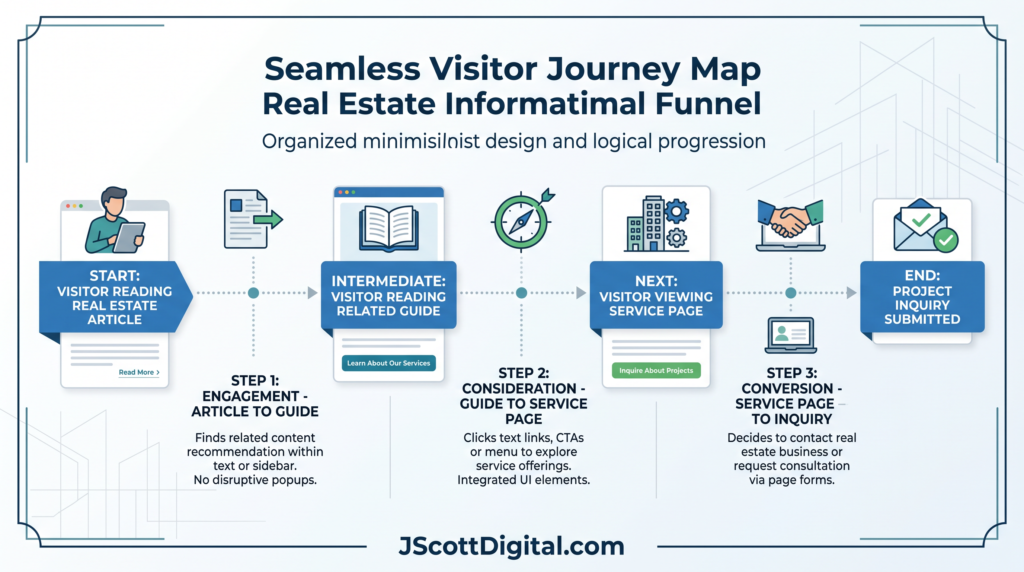
They land on a detailed article explaining which costs typically affect NOI. The page opens cleanly, and the reader can begin without closing a popup or dismissing a consultation banner.
That timing has a UX basis. Baymard Institute’s research on promotional overlays has found that overlays appearing before users can pursue their original task are frequently dismissed and can become an interruption rather than an aid.
The First Move Is Another Answer
Halfway through the article, the discussion turns to estimating future expenses. A contextual link points to a rental-property expense worksheet.
The reader clicks because the resource solves the next problem that naturally arose from the article. No email address was required to create that first step.
Later, the worksheet page offers a downloadable version that can be saved and reused. Asking for an email address is more reasonable here because the visitor receives something with value beyond the current page.
By this point, real estate website lead generation is happening without forcing a sales interaction.
Commercial Intent Shows Up Later
After working through the material, the same visitor may explore a case study or service page. Now a direct inquiry fits the context.
The path might be:
Search → article → worksheet → case study → service page → inquiry
Another reader may stop after the worksheet. Someone else could subscribe to a newsletter and return months later.
Those outcomes reflect different levels of intent, not failed funnels.
Match the Strength of the Ask to the Strength of the Signal
A visitor’s actions tell you something about how much commitment is reasonable to request.
Reading an article is a weak commercial signal. Reviewing a case study is stronger. Spending time on a service page and opening a project form indicates something different again.
Low Commitment
Use a calculator. Read a related guide. Explore a glossary term. View another article.
Medium Commitment
Download a worksheet. Subscribe to a newsletter. Request a report.
High Commitment
Start a project. Request a proposal. Schedule a consultation.
Strong real estate website lead generation does not push every visitor toward the high-commitment action. It gives people an appropriate step based on the signals they have already provided.
Form design creates a second conversion problem: asking for information that has little to do with the offer.
A newsletter signup usually needs an email address. Adding company size, phone number, investment experience, and a project timeline creates work without improving the subscription.
A detailed project inquiry is different. Knowing the company, website, project type, and approximate scope may help you respond more intelligently.
Instead of chasing the shortest possible form, match the information requested to the value of the exchange.
Unbounce’s guidance on lead-generation forms describes the tradeoff between reducing form friction and collecting enough information to understand lead quality. The right number of fields therefore depends on what happens after submission, not on an arbitrary conversion rule.
Usability also extends beyond form length. WebAIM’s accessible form guidance emphasizes clear labels, logical structure, understandable instructions, keyboard accessibility, and useful error handling.
A form can be short and still be difficult to use.
Identify the Pages That Should Not Sell Hard
Once a company decides that its website should generate more leads, every popular page can start attracting new buttons, banners, forms, and promotional boxes.
That can work against the reason the page performs well in the first place.
A glossary may need nothing more than contextual links to related definitions and deeper resources. Calculators often benefit from explaining the result before introducing a commercial next step. An informational article can place its primary CTA after the reader has received the promised answer rather than interrupting the explanation.
Some high-traffic pages may never become strong direct lead generators. They can still earn links, introduce new visitors to the site, support search visibility, or give prospects material they return to during a longer decision process.
Our Real Estate Websites & Digital Publishing work treats resource libraries, information architecture, landing pages, and lead-generation systems as connected parts of the website rather than separate layers added after publishing.
Read the Analytics as a Sequence
A completed inquiry form is the end of a path. Looking only at that final event hides what helped create it.
Suppose Article A attracts 8,000 visits but sends almost nobody deeper into the site. Article B receives only 1,500 visits, yet a meaningful share of those readers continue to a guide, use a tool, view a case study, or reach a service page.
Traffic alone favors Article A. The visitor sequence may make Article B far more valuable to the business.
A useful measurement plan can follow movement between stages:
You don’t need every event on a dashboard. The point is to see whether the site helps interested readers move forward instead of measuring success only after someone fills out a form.
Let Useful Content Do Some of the Selling
Strong educational websites don’t need to act impatient.
A reader who gets a clear answer, discovers a useful tool, and finds another relevant guide is already learning something about the business behind the site. Expertise becomes visible through the experience rather than through repeated sales claims.
That is why effective real estate website lead generation can look quieter than a traditional conversion funnel.
The site earns attention first. Relevant paths make deeper engagement easy, and stronger calls to action appear only when visitor behavior supports them.
Qualified prospects still get an obvious way to reach the business. Other visitors can get the information they came for without fighting through a sales process.