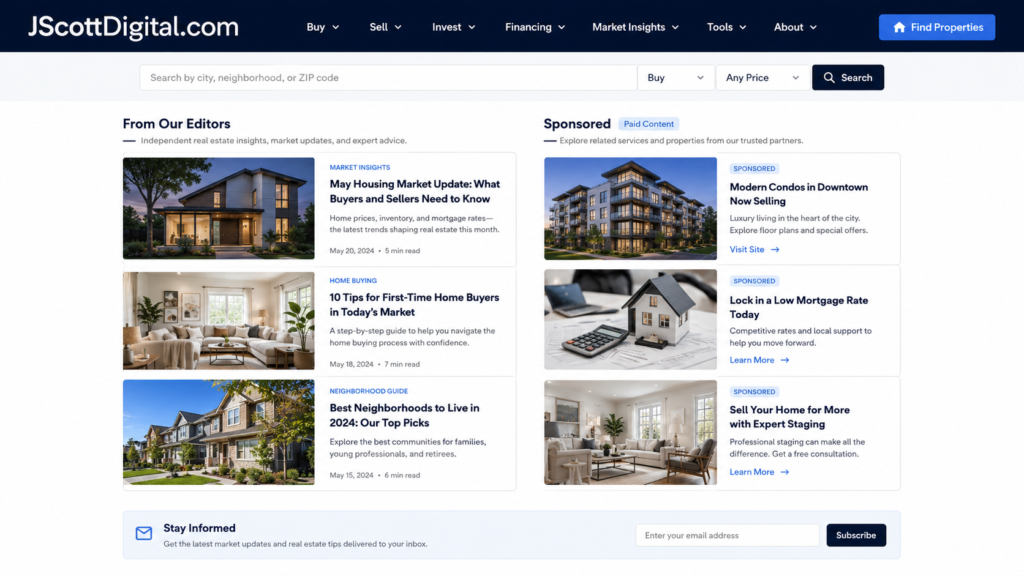
That question gets surprisingly close to the real credibility test. A paid article doesn’t have to look independent, and it shouldn’t. What matters is whether the reader can immediately understand the commercial relationship and still find enough useful information to justify the click.
For real estate publishers, the stakes can be higher because sponsored articles often touch lending, investing, insurance, property management, housing, and other subjects where an exaggerated claim can do more damage than an annoying sales pitch.
A practical way to evaluate real estate sponsored content is to stop treating every paid article as simply “acceptable” or “unacceptable.” Put it through a traffic-light review instead.
Put the Draft Through a Traffic-Light Review
Status
What you’re seeing
Editorial response
Green
Clear sponsorship, relevant topic, supportable claims, useful information
Publish after normal review
Yellow
Useful core, but too promotional, vague disclosure, weak sourcing, or excessive product mentions
Revise before approval
Red
Misleading framing, unsupported performance claims, hidden sponsorship, or poor audience fit
Reject or rebuild
This changes the conversation with a sponsor. Instead of debating whether an article “sounds too salesy,” you’re evaluating specific credibility problems.
Green: Commercial and Still Worth Reading
Imagine a property-management software company sponsoring a guide to maintenance-response workflows.
The article explains several ways managers can organize requests, track response times, document vendor work, and communicate with residents. The sponsor’s platform appears as one example of how those tasks can be handled.
A reader who never buys the software can still learn something useful.
That’s a healthy exchange. The advertiser gets relevant exposure, the reader gets information, and the publication keeps its standards intact.
Yellow: There’s a Good Article Buried in the Promotion
Yellow drafts are often fixable.
Maybe the topic fits perfectly, but the sponsor appears in every section. A useful statistic has no source. The headline promises education while the body reads like a product page. Or the disclosure says “Partner Perspective,” leaving readers to figure out what the relationship actually means.
The FTC’s native advertising guidance explains that advertising resembling surrounding editorial material may require clear and prominent disclosure so consumers understand its commercial nature. The agency also discusses straightforward terminology such as “Ad,” “Advertisement,” and “Sponsored Advertising Content.”
Yellow content doesn’t necessarily need less sponsor involvement. It needs a cleaner line between useful information and commercial persuasion.
Red: The Revenue Isn’t Worth the Credibility Cost
Now consider a sponsor that wants a “market analysis” whose conclusion was decided before the research began.
Another advertiser insists that a projected investment return be presented as though it were typical. A third objects to any disclosure readers might recognize as advertising.
Those aren’t minor copy problems.
The ANA Ethics Code of Marketing Best Practices centers its ethical marketing framework on practices intended to promote responsible marketing and maintain consumer trust. A commercial objective doesn’t eliminate the need for truthful, transparent communication.
Sometimes the appropriate editorial response is simply not publishing the piece.
One Sponsorship Brief, Six Editorial Decisions
Put the issue into a real estate setting.
A lending company wants to sponsor an article titled “How Rental Property Owners Can Prepare for Refinancing.”
Good topic. Relevant advertiser. Plenty of potential reader value.
Then the brief arrives.
Sponsor request: “Don’t use the word sponsored near the headline.” Editorial decision: No. The paid relationship needs to be easy to recognize before the reader invests time in the article.
Sponsor request: “Mention our lending platform in the introduction.” Editorial decision: Maybe. If the reference naturally explains why the sponsor is contributing expertise, it can work. When the mention interrupts the reader’s problem, it belongs somewhere else.
Sponsor request: “State that our process makes refinancing easier.” Editorial decision: Substantiate or rewrite. “Easier” sounds harmless until you ask: compared with what, measured how, and for whom?
Sponsor request: “Include three links to our application page.” Editorial decision: Probably unnecessary. One relevant call to action can do the job without turning the article into a sequence of exits.
Sponsor request: “Remove discussion of situations where refinancing may not make sense.” Editorial decision: No. An educational article becomes less useful when an important part of the decision is deliberately omitted.
Sponsor request: “We want final approval before publication.” Editorial decision: Yes, with limits. A sponsor can verify product facts and confirm that its position is represented accurately. Final control over what appears on your publication still belongs with the publisher.
This is where real estate sponsored content usually succeeds or fails—not through one dramatic choice, but through a series of smaller decisions about whose interests control the page.
A disclosure is often treated as something that belongs at the top of an article.
The reader’s journey may start somewhere else.
Someone might first encounter sponsored content in a newsletter, homepage card, social post, related-content module, or another distribution channel. That means clarity needs to survive beyond the article page itself.
When a paid article appears beside ordinary editorial stories, the sponsorship label should appear there too.
Readers shouldn’t have to click first and find out later.
At the Top of the Article
Keep this simple.
Sponsored Content | Presented by ABC Lending
The purpose is understanding, not clever branding.
Inside the Article
You normally don’t need to remind readers every few paragraphs that they’re reading sponsored material.
Instead, make it clear when a claim, statistic, product feature, or viewpoint originates with the advertiser.
At the Call to Action
A commercial destination should look commercial.
When the final link leads to an application, quote request, demo, or product page, the wording should make that destination predictable.
Transparency isn’t one label buried somewhere on the page. It follows the reader from first impression to final click.
Decide What the Sponsor Is—and Isn’t—Buying
Many sponsored-content disputes can be prevented before anyone writes a sentence.
A useful boundary looks like this:
Sponsor can reasonably influence
Publisher retains control over
Campaign topic
Accuracy
Target audience
Disclosure
Product information
Terminology
Subject-matter input
Supporting evidence
Company facts
Misleading or unsupported claims
Desired call to action
Final publication standards
That distinction doesn’t make the relationship adversarial. It makes the arrangement predictable.
Our Advertising Opportunities are built around specialized real estate audiences, which makes advertiser relevance part of the commercial equation rather than something considered after a campaign has already been sold.
A company that naturally fits the audience begins from a much stronger position because you don’t have to force its subject matter into the publication.
What Happens When the Sponsor Wants Too Much?
This is where a useful campaign can gradually turn into an advertorial nobody particularly wants to read.
The first draft contains one product reference.
Marketing asks for another.
Sales wants a company biography added.
Someone requests three more links. The sponsor wants its name in the headline. A final reviewer adds a paragraph explaining why the product is “industry leading.”
By publication day, the educational article has disappeared.
There’s nothing inherently wrong with selling a product inside sponsored content. The reader already knows a commercial relationship exists.
The problem is proportion.
When every section steers back to the advertiser, you stop rewarding the reader for paying attention. At that point, a conventional display ad or landing page might be the more straightforward format.
Run the 10-Second Credibility Test
Forget the contract for a moment.
Ignore the campaign budget, revision history, and how much work went into getting the sponsor’s approval. Look only at the finished page.
Give yourself 10 seconds.
Can you immediately tell that it’s sponsored?
Can you tell why this subject belongs on your site?
Does the page offer something beyond “buy from this company”?
Those three answers reveal quite a bit.
An unclear sponsorship label points to a disclosure problem. A strange topic suggests an audience-fit problem. An article that offers nothing beyond the sales pitch has a value problem.
Credible real estate sponsored content doesn’t need to disguise the advertiser or drain every commercial message from the page.
The bargain with the reader simply needs to be clear: this company paid to be here, the subject is relevant to you, and our publishing standards still apply.
When all three are visible, the sponsorship can remain unmistakably commercial without asking the audience to lower its standards.