Improve Real Estate Content Discoverability Across Search and AI
September 22, 2026
A useful real estate article can answer exactly the question a prospective client is asking and still attract very little visibility.
The page may be technically sound and well researched, yet buried deep in the site. Its title may be vague, the main answer may appear halfway down the page, or related articles may never link to it. Search engines have less context, AI systems have fewer clear passages to retrieve, and readers have fewer paths to reach the content.
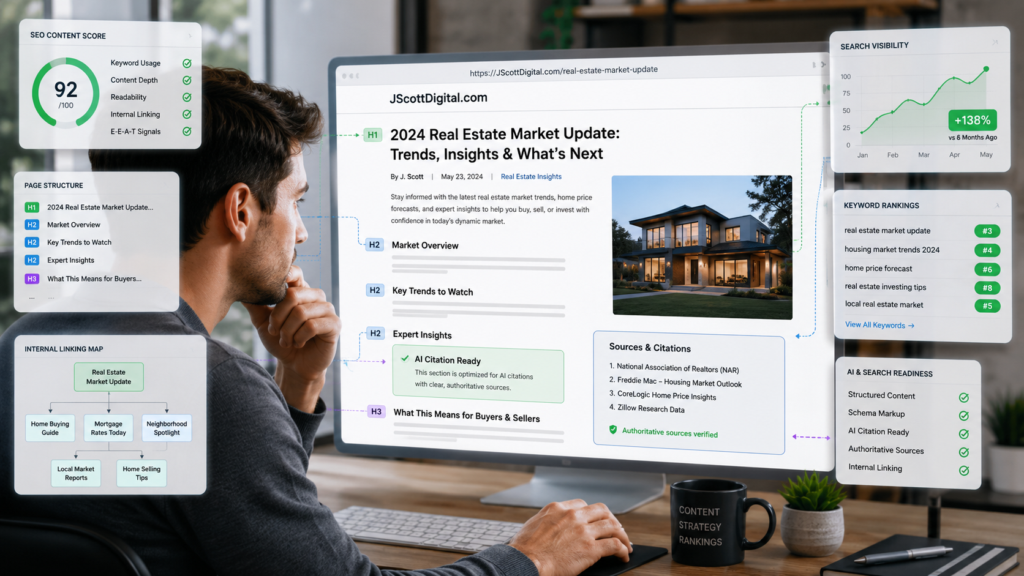
Better real estate content discoverability comes from making the same page easier to identify, retrieve, verify, and connect. You do not need separate articles for traditional SEO and AI search. Improve the underlying page so both people and discovery systems can understand what it covers.
One Article Can Be Discovered Three Different Ways
Take a guide explaining debt-service coverage ratio for rental property.
A reader might reach it through a Google search for “DSCR real estate.” Someone else may see the article cited in an AI-generated answer about lender requirements. A third visitor could arrive from your own guide to rental-property financing.
Clear explanations, evidence, terminology, current information
Your own website
Internal links, resource hubs, descriptive anchor text
The page should support all three without becoming three versions of the same article.
Make the Main Subject Impossible to Miss
“Understanding Important Rental Property Metrics” could contain an excellent DSCR explanation, but the title gives readers and search systems little reason to treat DSCR as the main subject.
A clearer title would be:
What Is DSCR in Real Estate and How Is It Calculated?
Then answer the question early:
Debt-service coverage ratio compares a property’s net operating income with its annual debt obligations. A DSCR of 1.20 means the property generates $1.20 of NOI for every $1.00 of annual debt service.
The formula, a worked example, lender considerations, and limitations can follow.
Use Headings That Name the Information
Replace vague subheads such as What You Need to Know with How DSCR Is Calculated.
Instead of A Few Things to Consider, use Why Lenders Use Different DSCR Requirements.
Descriptive headings help readers scan the page and give the content a clearer topical structure.
Write for Retrieval Without Writing for a Robot
AI search has encouraged advice about special formatting, separate “AI versions” of pages, and new optimization layers.
Google’s current guidance for generative AI features in Search says established SEO practices remain relevant and emphasizes crawlable technical structure, useful original content, and clear information. The same guidance says Google does not require special AI markup, dedicated AI text files, or tiny content “chunks” simply to appear in its generative search features.
Structure still matters when it helps the reader. Short answers work when the question calls for one. Longer explanations belong where the subject needs context. Tables, definitions, and examples should make the page easier to use rather than satisfy a supposed AI template.
Keep essential explanations in visible page text as well. A chart or calculator can support the article, but the reader should not need an image or interactive element to understand the core point.
Real estate content often carries facts that deserve verification.
Mortgage requirements, market statistics, capitalization rates, tax rules, lending standards, and regulatory information can be misstated or become outdated.
For a DSCR article, separate the formula from lender policy:
DSCR = Net Operating Income ÷ Annual Debt Service
A property producing $150,000 in NOI with $120,000 in annual debt service has a DSCR of 1.25.
A statement such as “lenders require a 1.25 DSCR” needs more care because requirements can vary by lender, loan program, property type, and market conditions.
Clear sourcing helps readers inspect the claim and gives retrieval systems stronger context when the page is used as a reference.
Make Related Pages Reinforce One Another
Discoverability is also a site-architecture problem.
A DSCR article should not sit alone if the site already has useful pages about NOI, LTV, cash-on-cash return, financing, and rental-property analysis.
Link those subjects where they naturally intersect. A financing guide can link to the DSCR article when debt coverage appears, while the DSCR page can direct readers to a fuller explanation of NOI when the formula is introduced.
Descriptive anchor text adds context. “See how net operating income is calculated” tells the reader more than “learn more.”
This is also where our Real Estate Websites & Digital Publishing work becomes relevant. Information architecture and resource-library planning help establish relationships between pages as part of the publishing system rather than adding links after the articles are already live.
Do Not Create a Second Editorial Standard for AI
One easy way to weaken a content library is to start writing differently because “AI search” sounds like a separate audience.
Avoid awkward definition blocks, repetitive FAQ sections, or pages built around every possible prompt variation when those additions do not improve the article.
For Google Search, current guidance does not require a separate AI content format. Other systems may use different crawling or retrieval methods, but the durable editorial standard remains useful: publish information that is clear, specific, supported, accessible, and connected with related subjects.
That approach improves real estate content discoverability without turning the page into machine-facing copy.
Measure Search Visibility and AI Citations Separately
Traditional search and AI visibility do not produce identical metrics.
Search Console can show impressions, clicks, queries, and landing-page performance. Bing Webmaster Tools now provides an AI Performance report showing cited pages, citation trends, and grounding queries across supported Microsoft AI experiences. The report notes that citation activity is different from ranking, traffic, authority, or clicks.
Use each view for a different question.
If a page earns search impressions but few clicks, review the title, snippet, and intent match. When a page is cited repeatedly in AI answers around one subject, that can show where its explanation is being retrieved even if referral traffic remains modest.
Connect both visibility signals with what readers do after they reach the site.
A page can remain indexed while becoming harder to interpret.
Statistics age. Internal links break. New sections get added without a clear hierarchy. Two URLs may drift into answering the same question.
For an important page, check four points:
Focus — Can you describe its main question in one sentence?
Evidence — Are material claims current and supported?
Connections — Do internal links reflect the site as it exists today?
Overlap — Is another page competing for the same job?
Some pages need a light refresh. Others are better candidates for a rewrite or merge.
Make Existing Content Easier to Find
A site with 300 articles does not always need article 301.
Choose one commercially relevant page and inspect how easily someone can discover and understand it. Clarify the title, strengthen the opening answer, improve headings, verify sources, and connect the page with related resources.
Then watch how its search visibility, internal traffic, and AI citation activity change over time.
That is a practical way to improve real estate content discoverability without chasing every new search acronym or publishing more pages simply to increase volume.
Search and AI systems will continue to change. A focused, crawlable, well-supported page that is connected to the rest of the site gives you a stronger base across both.