Real Estate Business Blog Content for Better Decisions
September 21, 2026
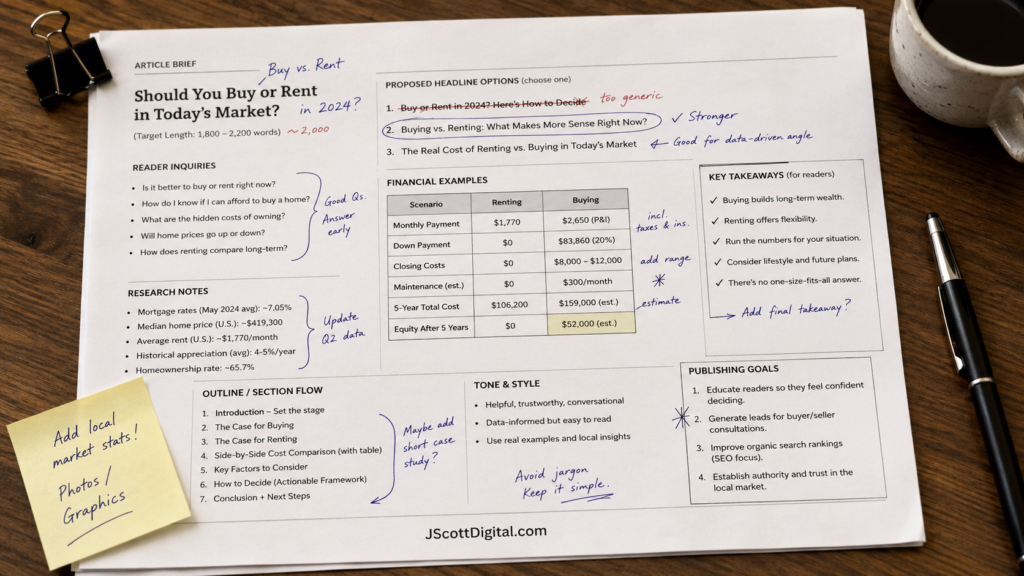
A prospective client can learn more from one detailed article than from several pages of marketing copy.
If the article explains a difficult real estate question clearly, uses credible evidence, and shows how the business thinks, the reader gets something useful before ever filling out a form. A generic post assembled around a keyword does the opposite: it adds another URL without giving the business much authority.
Strong real estate business blog content starts with a reader decision and a business reason for covering it. The article should answer the question well enough to stand on its own while making the company’s expertise visible through the quality of the explanation.
A Topic Brief With No Useful Information
Suppose the assignment says:
“Write 1,200 words about multifamily operating costs.”
There is enough information to produce a draft, but almost none to produce a useful business article. The writer still has to guess who the reader is, why the subject is relevant, and what the article should help that person understand.
Rewrite the brief:
“Explain how rising insurance, maintenance, and utility costs can change NOI and acquisition assumptions for small and midsize multifamily investors.”
The subject remains multifamily expenses. Everything around it becomes clearer.
The intended reader is an investor. Property economics drives the decision. The article needs to connect operating costs with NOI and underwriting rather than compile a general list of expenses.
That is the difference between assigning a topic and commissioning an article.
Decide What the Reader Should Understand by the End of the Message
Educational business content needs a destination.
For the multifamily example, the desired takeaway might be:
“An acquisition can look attractive based on rent growth while becoming less attractive when operating expenses are rising faster than income.”
Now the article has an editorial promise. Every section should help explain or support it.
A useful brief can capture four items:
Reader: Small and midsize multifamily investors.
Question: How can rising expenses change a deal that still shows strong revenue?
Evidence: Expense data, an NOI example, and relevant market or operating sources.
Business connection: Demonstrate practical knowledge of property analysis.
Gartner’s B2B content research says digital content is most useful when it helps buyers complete critical tasks during a purchase decision. That principle fits a real estate business blog: an article earns its place by helping the reader understand or evaluate something rather than simply keeping the website active.
Incorporate Your Expertise Into the Explanation
A service page can claim that a company understands real estate analysis. Blog content can show the reader how that analysis works.
If operating expenses rise to $270,000 while income stays flat, NOI falls to $330,000. At a 6% capitalization rate, the $30,000 NOI decline represents $500,000 of value under a simple income-capitalization calculation.
The example does more than define NOI. It shows why an investor should care about expense assumptions.
This is where subject-matter knowledge changes the article. Someone who understands property economics can decide which assumptions need explanation, where a caveat belongs, and which comparison will help the reader interpret the numbers.
Business blogs lose credibility quickly when marketing language replaces support.
Compare these statements:
Promotional
“Our expert team understands the complex challenges facing today’s multifamily investors.”
Educational
“Insurance, payroll, utilities, repairs, and property taxes can move independently of rent growth, so underwriting each expense line separately can reveal risk hidden by stronger revenue.”
The second sentence never calls the writer an expert. It gives the reader a reason to infer expertise from the explanation.
Forrester’s 2026 B2B content analysis found that buyers want clarity, evidence, and expertise, while product-centric and self-referential material often falls short. That distinction is especially relevant to real estate business blog content because technical credibility is easier to demonstrate through accurate reasoning than through adjectives.
Make Technical Writing Easy to Understand
Real estate gives you plenty of specialized language: cap rate, DSCR, LTV, NOI, absorption, basis points, concessions, yield, and dozens of other terms.
Use technical vocabulary when it adds precision. Explain it when the likely reader may not know it, and avoid adding jargon simply to make the article sound sophisticated.
Digital.gov’s plain-language guidance recommends writing for the specific audience, paying attention to the questions users ask, and examining website behavior to understand what people need. The same approach works for a real estate business blog. Readers should spend time understanding the idea, not decoding the prose.
Tables, short worked examples, comparisons, and descriptive subheads can make a technical article easier to scan without reducing its substance.
Keep the Business Links in Proportion
An educational article does not need repeated reminders that the company offers services.
One relevant connection is usually enough.
If an article about real estate content quality naturally demonstrates the type of work a company performs, a contextual link can help readers who want to understand that capability. Our Real Estate Content & Editorial work covers real estate writing, research, editing, fact-checking, and content-library development, making it a natural extension for readers interested in the professional work behind this type of publishing.
The rest of the article can stay focused on the reader’s question.
Give the Draft a Business-View Content Edit
A final edit for a company blog should ask different questions from a grammar review.
First, remove statements that exist mainly to praise the business. Replace them with evidence, examples, or useful explanation.
Next, inspect broad claims. “Investors prefer,” “the market is shifting,” or “this strategy reduces risk” may need qualification, a narrower scope, or a source.
Then look at the article’s sequence. The reader should not have to pass through several generic paragraphs before reaching the information promised by the headline.
Finally, check the ending. A conclusion should finish the argument rather than suddenly turn into a sales pitch.
Those edits improve both the educational value and the commercial value because the article becomes a stronger example of the company’s judgment.
A business blog article can contribute in several ways, but one job should usually lead.
An evergreen explainer may be designed primarily for search visibility. A technical article can demonstrate expertise to prospective clients. Another post might answer a question that repeatedly slows down the sales process, while a detailed guide can strengthen a larger resource library.
Knowing the primary job changes what you measure.
For a search-led article, qualified organic traffic and related-query visibility may deserve attention. An expertise article could be evaluated through engagement, internal navigation, referrals, or use during business development. A resource-library piece may become valuable because other pages can link to it whenever the subject appears.
Contact-form submissions are useful, but they are not the only evidence that a business article is doing useful work.
Build a Blog That Shows What the Business Knows
One good article is helpful. A collection of strong articles becomes a public record of expertise.
Over time, prospective clients, investors, partners, and referral sources can see which subjects the business understands, how it handles evidence, and whether its explanations hold up when the topic becomes technical.
That is the larger value of real estate business blog content.
Start with a specific reader problem. Connect it to an area where the business has credible experience, support the explanation with evidence, and publish something useful enough to deserve a permanent place on the website.
The blog then does more than keep the site current. It gives readers material they can use to judge the business before they ever speak with it.