
Posts Tagged ‘AI-Assisted Editing’
Where AI-Assisted Editing Helps—and Where It Fails

An AI tool can spot 47 inconsistent uses of “multi-family” in seconds. It can also “improve” a correct explanation of net operating income until the sentence sounds smoother and means something different. That contrast is the practical dividing line for AI-assisted editing. The technology is useful when the task is repetitive, bounded, and easy to…
Read MoreHow AI Slop Erodes Real Estate Content Quality

Publishing more real estate articles can actually make a website weaker. When AI-assisted production outruns editorial control, a library can fill with overlapping pages, recycled explanations, stale market claims, and conflicting terminology long before anyone notices a single catastrophic error. That is a portfolio-level real estate content quality problem. This article shows how to spot…
Read MoreAI Can Write the Draft. People Make It Worth Reading

AI gave every business a faster way to produce content. It did not give every business something worth saying. You can now generate an outline and a polished draft in less time than it once took to organize research notes. Yet when that draft is published with only minor editing, it often sounds like dozens…
Read MoreHow to Use AI Tools for Real Estate Content Without Guesswork
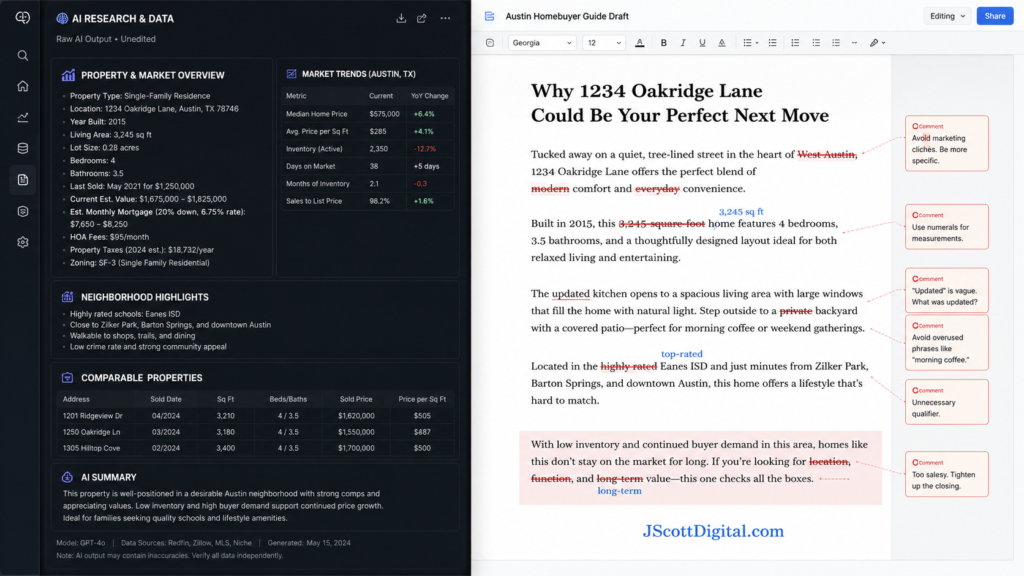
AI tools can make content creation faster, but speed is not the same as quality. If you use ChatGPT or similar tools casually, you may get a usable paragraph, a generic outline, or a few headline ideas. If you use them with stronger command, you can build a more efficient workflow for research, drafting, editing,…
Read MoreWhy AI Cannibalism Requires a Real Estate Content Editor

Artificial intelligence can help your real estate company produce content faster. It can organize research, summarize reports, suggest article structures, and turn a rough set of notes into a readable draft. But faster production creates a new editorial risk. The AI tool may be working from information generated or summarized by another AI system. That…
Read MoreAI Governance in Real Estate: What Human Oversight Can Cover
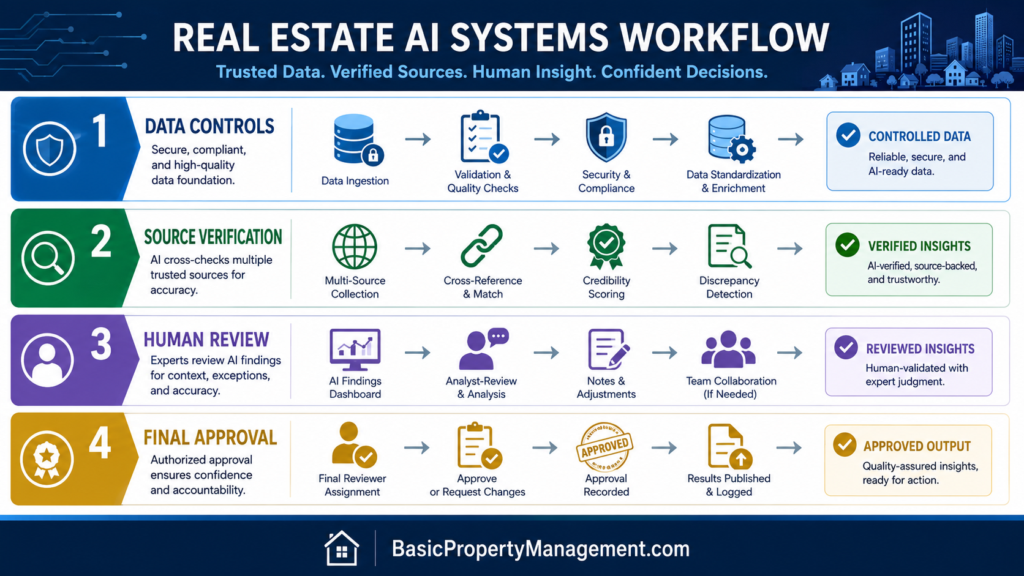
Artificial intelligence becomes a governance issue when its output influences a customer, investor, tenant, employee, or business decision. At that point, your firm needs to know what the system was asked to do, which information it used, who checked the result, and who is accountable for the outcome. That is the practical purpose of AI…
Read MoreHow to Use AI for Real Estate Business Without Costly Errors

Artificial intelligence can help a real estate firm research topics, organize documents, refresh website content, draft communications, and reduce repetitive work. It can also produce a confident answer that is incomplete, outdated, or wrong. That creates a practical challenge. Your firm may want the speed of AI, but clients, investors, tenants, and business partners still…
Read More