AI Governance in Real Estate: What Human Oversight Can Cover
July 15, 2026
Artificial intelligence becomes a governance issue when its output influences a customer, investor, tenant, employee, or business decision. At that point, your firm needs to know what the system was asked to do, which information it used, who checked the result, and who is accountable for the outcome.
That is the practical purpose of AI governance in real estate. It is not a general statement that your company intends to use technology responsibly. It is the operating framework that determines where AI may be used, where it may not be used, and what must happen before an output leaves the business.
Real estate firms need this framework because AI rarely stays confined to one department. Marketing may draft property content, acquisitions may summarize reports, property managers may prepare resident communications, and lenders may use models to support credit decisions. The risks differ, but the need for ownership and review is the same.
Govern the Use Case, Not the Tool
A common mistake is to approve an AI product once and assume every use of it is acceptable. The relevant question is whether a specific use has been approved for a particular purpose, dataset, and audience.
The same language model might be suitable for reorganizing public market reports but unsuitable for processing tenant applications. A document-analysis platform might help locate clauses in leases while still requiring legal review before anyone relies on its interpretation.
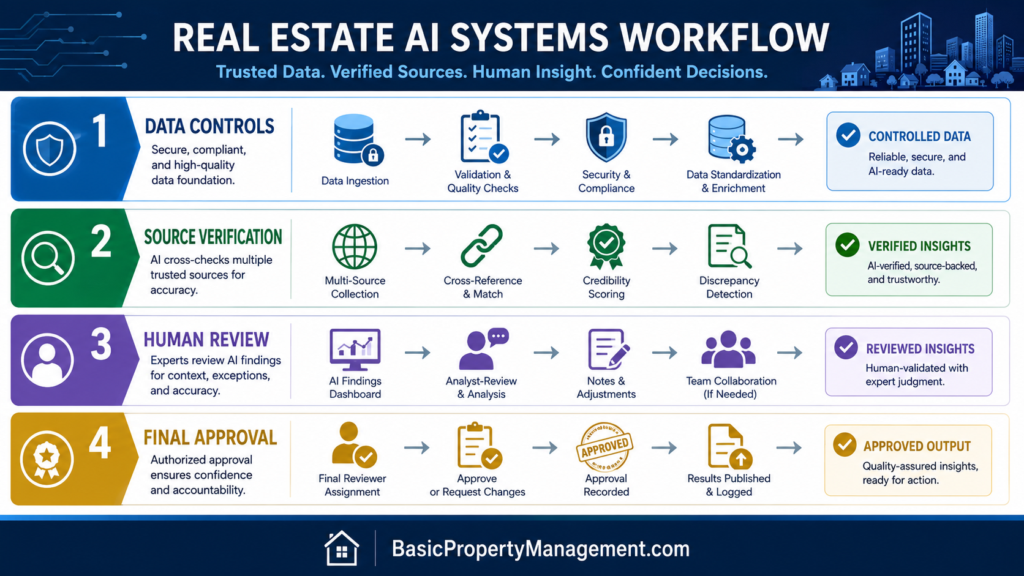
Organize governance records by use case. Each record should identify the business purpose, system owner, permitted and prohibited information, required sources, reviewer, and final approval point. It should also state what would cause the use to be paused, such as repeated errors, unexplained output changes, or a vendor change affecting data handling.
The FHFA’s AI and machine-learning risk-management guidance calls for defined responsibilities, inventories, data controls, validation, and ongoing monitoring. Although the bulletin applies directly to regulated housing-finance enterprises, its operating principles are useful for smaller firms controlling AI in their own workflows.
Build an Inventory Before Writing a Policy
Many firms begin with a lengthy AI policy that employees rarely consult. A more useful starting point is an inventory of how AI is already being used.
Ask department leaders what tools employees use, what information they enter, what outputs they produce, and whether anyone outside the company relies on those outputs. Informal use matters. An unapproved browser tool used by one employee may create more exposure than an enterprise platform with access controls and documented review.
The inventory will usually reveal several categories of activity. Some uses create internal drafts. Others generate public content, influence financial analysis, handle confidential records, or affect decisions about people. Those categories should not share the same approval standard.
An inventory can also reveal duplicate subscriptions, inconsistent review procedures, and separate teams solving the same problem in different ways. Governance should improve efficiency as well as control risk.
Match the Review to the Consequence
Human review is often treated as a universal safeguard, but “a person checked it” says little about the quality of the control. The reviewer must be qualified to evaluate the output and have enough evidence to challenge it.
For website content, that may mean an editor confirms the source, date, calculation, and real estate terminology. For an investment model, it may require an analyst who can reproduce the result independently. For a lease interpretation or fair-housing matter, the appropriate reviewer may be qualified counsel.
The level of review should increase with the consequence of an error. A brainstorming outline can tolerate uncertainty because it remains internal. A published market statistic, resident notice, underwriting recommendation, or investor communication cannot.
Credit decisions illustrate why this matters. The Consumer Financial Protection Bureau’s guidance on complex algorithms states that creditors must still provide specific reasons when taking adverse action, even when a complex model is involved. Model opacity does not remove the creditor’s obligation to explain the decision.
The broader governance lesson applies beyond lending. A system should not enter a consequential workflow unless the firm can understand, test, and document its output.
Require an Evidence Trail
AI output is easier to review when the system shows where its information came from.
A market summary should connect material claims to the original report. A lease abstraction tool should link extracted terms to the relevant clauses. A financial analysis should preserve the inputs, assumptions, and formulas used to reach the result. A content workflow should distinguish verified facts from suggested language.
Without that evidence trail, reviewers may accept plausible output because verifying every sentence is too time-consuming. The polished appearance of an answer can gradually become a substitute for checking it.
An evidence trail also makes errors easier to diagnose. You can determine whether the problem came from weak source data, an extraction failure, an incorrect instruction, or an inadequate review. Each cause requires a different response.
Separate Development From Approval
The person who builds an AI-assisted workflow should not be the only person deciding whether it works.
A small real estate firm may not need a formal model-validation department, but it still benefits from having someone other than the creator test assumptions and failure points.
Suppose an acquisitions team develops a workflow that summarizes rent rolls, operating statements, and lease abstracts. The analyst who built it may focus on speed and organization. An independent reviewer may notice that concession income is grouped inconsistently, lease options are missing, or source dates are not displayed.
That second perspective turns a demonstration into a controlled process. It also prevents enthusiasm for the project from becoming the primary standard used to approve it.
Case Study: The Acquisition Summary That Looked Complete
Consider a private real estate company evaluating small retail centers. The firm introduces an AI-assisted process to organize leases, tenant schedules, and historical operating statements before the first investment-committee discussion.
The summaries are clear and save the acquisitions team several hours per property. After a few successful tests, the group begins treating them as complete.
During a later review, an asset manager compares one summary with the source leases and discovers that the tool omitted a tenant’s termination option. It also categorized a one-time reimbursement as recurring income. Neither error was obvious from the polished output, but both could affect the preliminary valuation.
The firm does not abandon the tool. It changes the controls.
Every extracted lease term must link to the source clause. Nonrecurring income receives a separate classification. An asset manager reviews specified fields before the summary reaches the investment committee. The cover page also identifies which documents were included and which remained missing.
AI continues to reduce preparation time, but the company no longer confuses a well-formatted summary with verified analysis.
Treat Vendor Review as Part of Governance
Your internal procedures depend partly on the vendor’s security, data practices, product changes, and service continuity.
Before approving a system, determine whether prompts and uploaded files are retained, whether they may be used to improve the provider’s models, and whether administrators can control user access. Review deletion rights, subcontractors, incident notification, and data location when those issues matter to your business.
The contract and product settings should match the approved use. A tool suitable for public information may not be suitable for confidential client materials. A free individual account may lack the controls needed for a company-wide process.
Vendor performance claims also require scrutiny. Terms such as “fully automated,” “bias-free,” and “institutional-grade” are marketing language unless the provider can explain how those claims are measured.
Ask what the product actually does, which functions depend on third-party models, and what happens when the system cannot locate or interpret the required information.
Monitor for Drift, Not Just Failure
AI use can become riskier without producing an obvious incident. Employees may expand the workflow beyond its original purpose, add new data sources, skip review steps, or rely on outputs more heavily because earlier results appeared reliable.
Periodic monitoring should examine sample outputs, reviewer corrections, and whether employees are following the approved process. Revisit the use when the vendor changes models, the firm adds a new audience, or the output begins influencing a more consequential decision.
Near misses belong in the record. A fabricated source caught before publication or a missing lease clause found during review provides evidence that can improve the process before the same problem reaches a customer or decision maker.
The objective is not to punish employees for identifying a problem. It is to make certain that the organization learns from it.
Be Precise When Marketing AI Capabilities
Governance also covers how your company describes its use of AI.
Real estate firms may promote “AI-powered” underwriting, valuation, investment selection, or market intelligence without defining what the technology contributes. That language can create expectations the system cannot support.
The SEC has taken enforcement action against investment advisers over false or misleading statements about their use of artificial intelligence. The issue was not whether AI could provide value. It was whether the companies accurately represented how the technology was being used.
Real estate companies raising capital, publishing investment commentary, or marketing analytical capabilities should treat AI claims like any other material business claim: they should be specific, supportable, and reviewed.
“AI-assisted document organization with analyst verification” is more informative than “AI-driven due diligence.” It gives the customer a clearer understanding of the service and where professional judgment remains involved.
Create a Control Framework People Can Use
The best AI governance in real estate is visible in everyday work. Employees know which systems are approved, which information is restricted, when a source must be shown, and who can release the output. Managers can see where AI is being used and whether the control matches the consequence.
Begin with an inventory. Approve use cases rather than tools in the abstract. Preserve source evidence. Match reviewers to the subject. Separate development from approval. Monitor how the workflow changes after launch. Be precise when describing AI to clients, investors, and the public.
Those practices give your company room to use AI without allowing unclear ownership or undocumented decisions to become part of the operating model.