How to Build an AI Strategy for Real Estate Companies
July 14, 2026
Artificial intelligence is moving quickly into everyday business operations. Real estate firms are using it to organize documents, draft content, analyze information, respond to routine questions, and reduce administrative work. The appeal is obvious: faster output, lower production costs, and more capacity without immediately adding staff.
The difficulty is deciding where AI belongs in your business.
Buying several tools and encouraging employees to experiment is not an AI strategy. Neither is adding a chatbot to your website or asking a language model to complete tasks without defined controls. A practical AI strategy for real estate companies begins with business problems, assigns responsibility, and measures whether the technology produces a useful result.
The 2025 AI Index Report found that 78% of surveyed organizations used AI in 2024, up from 55% the previous year. Greater use, however, does not automatically mean better execution. Your advantage will come from choosing the right applications and managing them well, not from adopting the largest number of tools.
Start With the Business Objective
AI discussions often begin with software features. A better starting point is a problem that already costs your company time, money, or opportunity.
Perhaps your team spends too many hours reorganizing property reports. Your website contains hundreds of articles that are difficult to keep current. Leasing staff repeatedly answer the same preliminary questions. Investment analysts manually extract information from similar documents.
Define the outcome you want in plain language. “Use AI in marketing” is too broad to guide a project. “Reduce the time required to prepare the first draft of a market report while preserving source verification” is specific enough to test. So is “identify outdated statistics across the website before an editor reviews each article.”
A defined objective also makes it easier to reject attractive tools that do not solve a meaningful problem.
Look for Workflows, Not Isolated Tasks
AI creates more value when it improves a complete workflow rather than speeding up one disconnected step.
Consider the production of a quarterly market report. The workflow may include collecting source documents, extracting statistics, comparing periods, drafting commentary, checking calculations, obtaining approval, and publishing the final report.
AI might help organize source material, locate repeated data points, produce a preliminary comparison, or draft routine sections. It should not independently decide which market conclusions are valid or publish the report without review.
Mapping the full workflow helps you see where delays and errors actually occur. It also prevents a common mistake: automating the drafting stage while leaving research, approvals, and quality control unchanged.
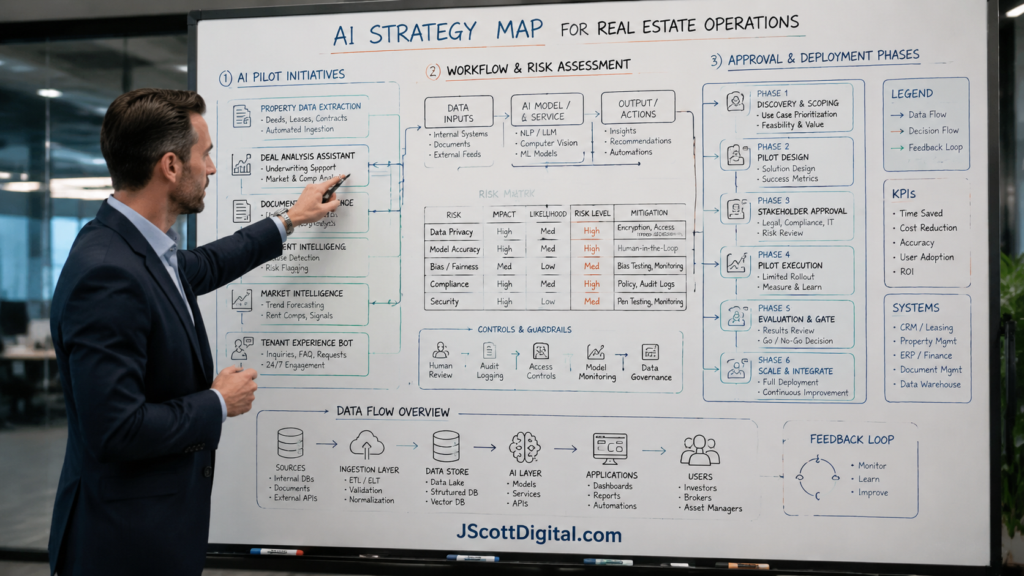
For each workflow, identify the input, the AI-assisted activity, the required human review, and the final owner. That creates a process your team can repeat instead of a one-time experiment.
Lower-risk uses generally create internal material that a knowledgeable person reviews before anyone acts on it. Examples include reorganizing meeting notes, suggesting article outlines, classifying documents, and preparing first-draft checklists. These applications are often suitable for an initial pilot because errors can be caught before they affect a client or transaction.
Moderate-risk uses may influence public content, marketing, research, or customer communications. They include drafting website articles, preparing property descriptions, summarizing market reports, and generating responses to common inquiries. These uses require source standards, subject-matter review, and a clear approval process.
High-risk uses affect access to housing, financial outcomes, confidential information, legal obligations, or material business decisions. Tenant screening, underwriting support, pricing recommendations, investment analysis, and automated professional guidance require greater technical, legal, compliance, and management review. In some cases, the correct strategic decision may be not to automate the activity.
The voluntary NIST AI Risk Management Framework provides a useful structure for evaluating these applications. It treats governance, context, measurement, and ongoing management as connected parts of AI risk control rather than a final review after deployment.
Decide What Data the System Can Access
An AI project is partly a data-governance project.
Before your team uploads leases, client records, financial statements, investor materials, operating procedures, or proprietary research, you need to know how the provider handles that information. You also need internal rules defining which materials are permitted.
A useful policy should distinguish between public information, approved internal information, confidential client material, personally identifiable information, and sensitive financial or legal records. Employees should not make these decisions individually each time they open a new tool.
Data quality matters as much as confidentiality. If your source material is outdated, inconsistent, or poorly labeled, AI may process it quickly without making it reliable. Many firms should begin with a small, controlled document set rather than connecting a new product to every available database.
The owner does not need to perform every step. They do need to understand the business objective, approve the permitted use, review performance, and decide when the process should be changed or stopped.
Without ownership, AI projects drift. Employees use different methods, standards vary by department, and no one records whether the output improves the business.
The OECD AI Principles emphasize human oversight, transparency, traceability, and accountability throughout the AI lifecycle. Those principles apply to smaller real estate companies as well as large organizations because responsibility cannot be outsourced to a software vendor.
Ownership should also cover vendor management. Your firm should know who approved the product, what terms govern its use, how access is removed when an employee leaves, and what happens if the provider changes its policies.
Choose a Pilot You Can Measure
Your first project should be meaningful enough to matter but limited enough to control.
A useful pilot has a defined starting point, a repeatable task, available source material, and a measurable result. Updating a group of older website articles may be more suitable than attempting to automate the entire marketing department. Extracting selected information from one standardized report type may be more manageable than analyzing every document used by an investment team.
Measure more than speed. A faster process that creates extra corrections may not produce real value.
Useful measures include total completion time, error rate, hours of expert review, consistency with approved standards, and the percentage of output requiring substantial revision. You may also track whether the workflow shortens turnaround time or allows experienced employees to focus on higher-value analysis.
Compare the AI-assisted process with the existing method. Otherwise, you will know that the tool produced output but not whether it improved the business.
Illustrative Case Study: A Real Estate Publisher Tests AI
Consider a real estate publishing company with a library of 600 educational articles. Many posts contain dated market references, inconsistent terminology, and links that need review. The company wants to use AI to accelerate content updates.
Its first idea is to ask an AI system to rewrite every article. That would create unnecessary risk because the system could alter accurate explanations, introduce unsupported claims, or remove useful context.
Instead, the company begins with 25 articles. The AI system compares each article with approved current sources, flags potentially outdated passages, identifies terminology inconsistencies, and produces an update summary. An editor then verifies the flags, decides which revisions are necessary, and completes the final rewrite.
The company measures the time required per article, the percentage of valid flags, the number of missed issues, and the amount of editorial revision. The pilot shows that AI reduces the time spent locating possible problems but does not replace editorial judgment.
This is a strategy because the project connects a business problem, a controlled use case, a responsible owner, and measurable outcomes. Simply purchasing the tool would not have achieved the same result.
Build Governance Before Scaling
A successful pilot should lead to a better operating system, not uncontrolled expansion.
Before adding departments or use cases, document the approved tools, permitted data, review requirements, recordkeeping, and escalation process. Specify who can authorize a new application and when legal, compliance, information-security, or subject-matter review is required.
You also need a way to monitor change. AI products, terms of service, capabilities, and limitations evolve. A workflow that was acceptable at launch may require reassessment later.
Governance does not need to become a bureaucratic obstacle. Its purpose is to let your company expand useful applications without repeatedly debating the same basic questions.
Keep AI Strategy Connected to Business Strategy
The strongest AI strategy for real estate companies does not begin with a prediction about how technology will transform the industry. It begins with disciplined decisions about your organization.
Identify the problem. Map the workflow. Classify the risk. Control the data. Assign ownership. Test a limited use case. Measure the result before scaling.
This approach is less dramatic than announcing an AI transformation, but it is more likely to produce durable value. Technology should improve how your business operates, not become a separate initiative with no clear connection to clients, revenue, quality, or risk.