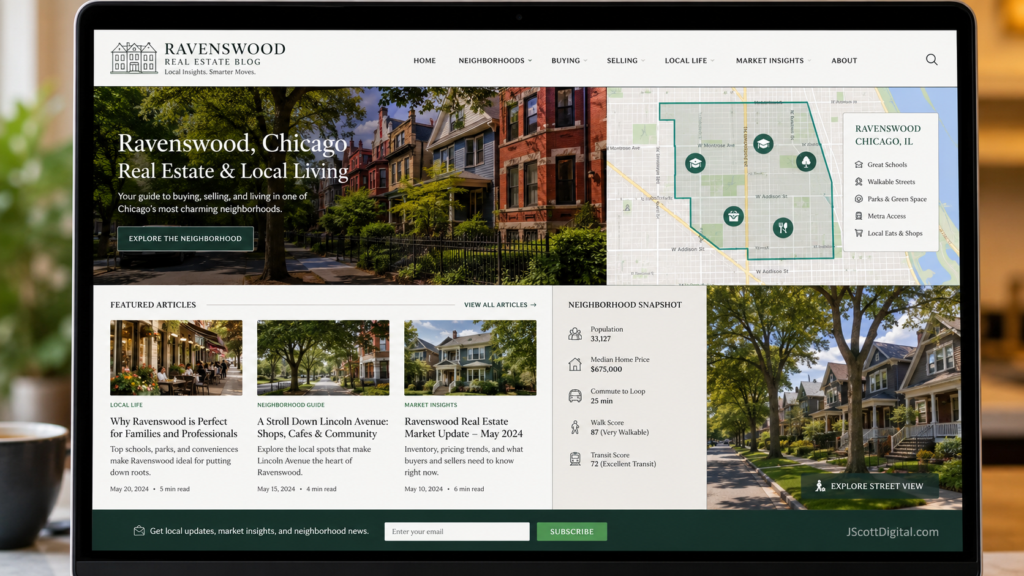
Create Hyper-Local Real Estate Blogs That Build Local Trust
August 10, 2026
A city name may bring someone to your website. The neighborhood details are what help that person decide whether you understand the place they are considering.
Buyers want to know how one area differs from the next. Sellers want to understand which local features and market changes may influence demand. Investors may be watching zoning, rental supply, or redevelopment within a few blocks—not across an entire metro area.
Hyper-local real estate blogs turn those narrow questions into useful content. Done well, they help readers make informed decisions, demonstrate genuine market knowledge, and create search-focused pages that generic city guides cannot replace.
Why Broad Market Content Often Misses the Reader
A citywide report can explain median prices, inventory, or overall sales activity. It rarely tells a reader what is happening around a specific subdivision, condominium district, commercial corridor, or planned transit stop.
Nearby areas can have different housing stock, ownership costs, development pressures, and buyer concerns. Weak neighborhood content does not explain those differences. It simply changes the place name inside a standard template.
A useful local article identifies what makes the location distinct and explains why it matters.
Start With a Local Question, Not a Location Keyword
The neighborhood name defines the subject, but it is not the angle.
Begin with a question someone might ask before buying, selling, or investing there:
How is new construction changing the housing mix?
What should buyers know about older homes in this area?
How do ownership costs differ among nearby condominium developments?
What could a planned road, transit, or zoning change mean for owners?
Why do homes in two sections of the same neighborhood perform differently?
Each topic connects a place to a decision. That gives the article a purpose beyond ranking for the neighborhood name.
Google advises publishers to create helpful, reliable, people-first content and to use the words people search for in prominent locations. Make the local topic easy to recognize, but give the reader more than a keyword match.
Research the Neighborhood Like a Reporter
Strong hyper-local real estate blogs are built from specific, current, and attributable information.
Depending on the topic, your research may include municipal planning documents, permit records, county property data, transportation projects, flood maps, association documents, market statistics, and firsthand interviews.
The American Community Survey provides annual housing, commuting, economic, and demographic estimates for defined geographic areas. Those datasets are useful, but boundaries such as census tracts may not match the way residents define a neighborhood. Explain the geography and limitations of the data you use.
Firsthand sources add context. An agent may notice recurring buyer questions. A property manager may see maintenance patterns in buildings from a certain era.
Treat those observations as leads to investigate, not facts to publish automatically. Verify claims, identify the source, and date information likely to change.
Show the Place Through Details
Local storytelling does not require inflated language. It requires observation.
Instead of calling an area a “hidden gem,” explain what is actually there. Describe the mix of housing, the age and design of common properties, the location of planned development, or the way a physical feature separates one section from another.
A useful article might explain that one side consists largely of detached homes built during a certain period while another contains newer townhouses and mixed-use projects. That detail helps buyers compare options and helps sellers understand how their property fits the local market.
Specifics make the content memorable. They also reduce the temptation to rely on interchangeable claims such as “great location” or “something for everyone.”
Keep Fair Housing and Editorial Judgment in the Workflow
Neighborhood content becomes risky when it shifts from describing property and place to suggesting who should live there.
Use objective, verifiable information. Avoid coded or subjective statements about the “right” residents, protected classes, or who would feel comfortable in an area. The Fair Housing Act prohibits discrimination in housing-related activities based on protected characteristics.
Schools, crime, demographics, and community characteristics require careful handling. When relevant, attribute the information, state the date and geography, distinguish data from opinion, and avoid using it to steer readers toward or away from a neighborhood.
Real estate content should be reviewed by someone who understands both the subject and the consequences of publication.
Build Pages Around Distinct Search Intent
A neighborhood should not have five articles that repeat the same overview.
Create a small content system in which each page answers a different question:
A cornerstone neighborhood guide
A current market update
A buyer article about local property types or ownership costs
A seller article about preparation and positioning
A development, zoning, or infrastructure update
Link the pages when the connection helps the reader, but do not make them compete for the same key phrase or recycle the same paragraphs.
This structure also simplifies maintenance. Market statistics can change without forcing you to rewrite an evergreen housing guide. A development article can be revised as project details change while the broader neighborhood page remains stable.
Make the Local Page Easy to Use
A reader may arrive with one narrow question and little patience.
Put the main takeaway near the beginning. Use descriptive headings, focused paragraphs, and comparison tables where useful.
A concise local facts panel might include:
Predominant property types
Common construction periods
Major transportation links
Significant current or planned projects
Data sources and review date
Choose visuals that explain something. A zoning map, development timeline, or housing-type comparison may provide more value than a generic streetscape photo.
Plan for Updates Before Publishing
Hyper-local content loses credibility when the details become stale.
Record the source and date for market figures, project timelines, transportation changes, and public plans. Assign a review schedule based on how quickly the subject changes.
A monthly market update may need frequent revision. An article about architectural styles may remain useful for years. A redevelopment story should be checked when approvals, construction dates, or project scopes change.
Update the substance rather than changing the date merely to make an old page appear current.
Use This Hyper-Local Content Check
Before publishing, ask:
Could the article apply to another neighborhood after changing the name?
Does it answer a real buyer, seller, or investor question?
Are local claims supported by current, credible sources?
Does it contain useful information competitors may have missed?
Has someone reviewed it for accuracy, fair housing concerns, and brand voice?
Is there a plan for keeping time-sensitive information current?
If the first answer is yes or several others are no, the article needs more work.
Turn Local Knowledge Into Content People Can Use
The best hyper-local real estate blogs do not merely mention a neighborhood. They explain it.
They connect local facts to practical decisions, show meaningful differences between nearby areas, and give readers evidence that the publisher understands the market. That can support search visibility, sales conversations, client education, and long-term brand authority.
J. Scott Digital provides real estate content and editorial services for firms that need neighborhood guides, market articles, website copy, editing, fact-checking, and ongoing content quality assurance.
Our work combines real estate subject-matter experience with research, SEO planning, and human editorial review. The goal is not to produce more location pages. It is to create local content that deserves attention and gives buyers and sellers a reason to trust the business behind it.