There was a time when SEO content could be built around one keyword, a few repeated variations, and a basic article structure. That approach is too thin for modern search. Today, a page needs to do more than include the right phrase. It needs to show that the topic is understood in context.
That is where semantic content optimization becomes useful.
Instead of asking, “How many times should this keyword appear?” you ask better questions. What does the reader actually want to know? What related concepts must be explained? Which entities, examples, definitions, and subtopics belong on the page? Where does this article fit within the larger website?
For real estate websites, this is especially important. A post about property management, foreclosure investing, BRRRR strategy, financing, or content marketing rarely exists in isolation. Each article sits inside a broader web of terms, people, organizations, asset types, legal concepts, financial assumptions, and reader intent. Semantic SEO helps you organize that web in a way that improves both rankings and reader experience.
Semantic SEO Begins Where Basic Keyword Targeting Ends
A keyword still matters. It tells you how people describe a problem in search. But a keyword alone does not tell you enough.
For example, if you are writing about “rental property cash flow,” the reader may also expect discussion of vacancy, operating expenses, debt service, capital expenditures, rent growth, reserves, and net operating income. Those terms are not decorative. They are part of the topic.
Google’s SEO Starter Guide notes that users with different levels of knowledge may use different search queries for the same subject. That is a useful reminder: a beginner and an experienced investor may search differently, but they may still need content that connects related ideas clearly.
Semantic content optimization helps you build those connections.
Stop treating related phrases as filler
Many people still use the phrase “LSI keywords” to describe related keywords. In practice, that phrase is often misused. What most content teams really mean is: include natural, relevant terms that help explain the topic more completely.
That distinction matters. You are not sprinkling terms into an article because an SEO tool gave you a list. You are deciding which terms actually belong because they help the reader understand the subject.
For an article about real estate content strategy, related terms might include topical authority, editorial workflow, content governance, internal linking, content refreshes, search intent, and information architecture. Some of those phrases may appear naturally in the post. Others may deserve their own article, service page, glossary entry, or case study.
Build Around Search Intent Before You Build Around Terms
Semantic SEO becomes much easier when you understand why the reader searched in the first place.
A search for “what is a cap rate” suggests informational intent. A search for “cap rate calculator” suggests tool-based intent. A search for “real estate investment analysis consultant” suggests commercial or service intent. Each query may connect to the same broad topic, but the content format should be different.
This is where many websites create content clutter. They publish several articles that appear to target different keywords but answer the same question. The result is overlap, weak internal linking, and possible keyword cannibalization.
A better approach is to assign each page a clear job.
Match the page type to the reader’s task
A blog post should explain, compare, clarify, or guide.
A service page should establish capability and create a conversion path.
A glossary page should define a term quickly and link to deeper resources.
A pillar page should organize a broad topic and route the reader to supporting content.
A calculator or tool page should help the reader complete a task.
When you choose the right format, your content becomes easier to understand. Search engines get a clearer signal, and readers do not have to work as hard to find the answer they need.
Topic Clusters Give Your Content a Larger Structure
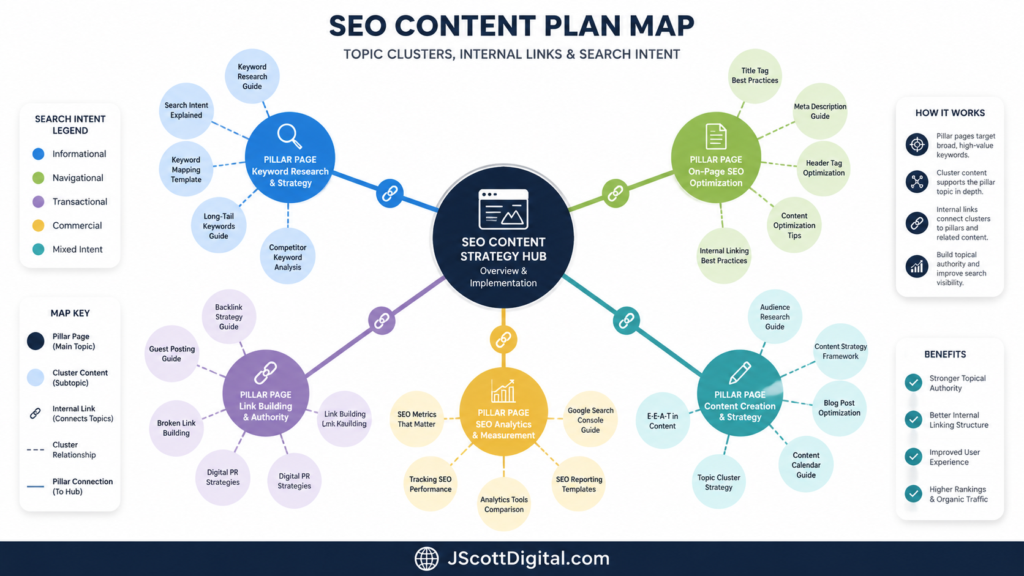
A topic cluster is a group of related pages connected around a central subject. The pillar page covers the broad topic. Supporting pages answer narrower questions, explain subtopics, or serve specific reader needs.
Search Engine Land’s guide to topic clusters describes this shift away from isolated keyword targeting toward broader topical coverage. For practical website planning, that is the key point. You are not just publishing posts. You are building an organized content library.
A real estate website might have a property management strategy cluster with pages on operating systems, tenant retention, maintenance planning, owner communication, portfolio growth, and performance metrics. Another cluster might focus on foreclosure investing, with supporting articles on auctions, title issues, renovation budgeting, financing, holding costs, and exit strategies.
Use internal links to show relationships
Topic clusters only work when the pages are connected. Internal links should help readers move from general to specific and from specific back to general.
For example, an article about maintenance reserves could link to a broader property management strategy page. A guide about content refreshes could link to a larger resource on content operations. A post about real estate website structure could link naturally to J. Scott Digital’s real estate websites and digital publishing services, where information architecture, resource libraries, and content-heavy publishing platforms are part of the service context.
The link should feel useful, not forced. If the reader would logically want the next resource, the link belongs.
Entity-Based SEO Makes the Topic More Specific
Entities are identifiable things: people, companies, places, concepts, property types, organizations, regulations, tools, and financial terms. Entity-based SEO matters because search engines work to understand meaning, not merely count word repetition.
In real estate, entities could include FHA, DSCR loans, 1031 exchanges, Phoenix, multifamily property, net operating income, CCIM, Zillow, Realtor.com, or a specific property management framework. These entities help define the subject area.
Search Engine Land’s explanation of entities, topics, and keywords is useful because it separates the roles of these concepts. A topic gives the page its broad subject. Keywords reflect how users search. Entities clarify what the content is actually about.
Add entities because they improve meaning
Do not add entities randomly. Add them because they make the page more precise.
A weak sentence says:
“Investors should look at several important numbers before buying a property.”
A stronger sentence says:
“Investors should review rent assumptions, vacancy, operating expenses, debt service, reserves, and net operating income before relying on projected cash flow.”
The second sentence does more than sound better. It gives the reader concrete decision points. It also gives search engines clearer context about the topic.
Comprehensive Content Does Not Mean Bloated Content
One common mistake in semantic content optimization is assuming that more words automatically mean more authority. That is not true.
Comprehensive content answers the reader’s question with enough depth to be useful. Bloated content repeats obvious points, adds loosely related sections, and tries to cover every possible angle on one page.
Google’s helpful content guidance asks whether content provides a substantial, complete, or comprehensive description of the topic. The word “complete” is important. It does not mean endless. It means the page should satisfy the reasonable expectations created by the title, keyword, and search intent.
Decide what belongs and what needs another page
If a section is essential to the reader’s understanding, keep it.
If a section is useful but too detailed, summarize it and link to a deeper article.
If a section serves a different search intent, move it to a separate page.
If a section exists only because an SEO tool suggested a term, delete it or rework it into something useful.
This editorial discipline protects UX. It also helps your topic clusters stay clean. Each page should have a defined role rather than competing with three other pages on the same site.
A Practical Semantic Optimization Workflow
Semantic SEO can sound abstract, but the workflow is straightforward.
Start with the primary search intent. Then identify the core topic, related subtopics, common questions, important entities, and natural internal links. Review competing pages, but do not simply copy their structure. Look for what they miss, where they are vague, and how your article can be more useful.
Next, draft the article around the reader’s path. Begin with the problem. Clarify the concept. Explain the decision points. Add examples. Link to supporting resources. Remove sections that drift away from the intent.
After the draft is complete, review the page for semantic coverage. Ask whether the article includes the terms, entities, and explanations a knowledgeable reader would expect. If not, add substance. If yes, avoid over-optimization.
Use tools, but keep judgment in control
Keyword tools, SEO platforms, and AI tools can help you identify related terms and gaps. They should not make the final editorial decisions.
A tool may tell you to include a term. It cannot always tell you whether the term fits the article, whether the reader needs it, or whether it belongs on another page. That judgment still belongs to the writer, editor, or subject-matter expert.
This is especially true in real estate content, where a technically related term may create confusion if it is introduced without context. A strong page is not just semantically rich. It is readable.
Make Meaning the Center of the Page
Semantic content optimization is not a trick. It is a better way to plan, write, and organize content.
You still need keyword research. You still need clear titles, headings, meta descriptions, and internal links. But those elements work best when they support a larger purpose: helping the reader understand a topic completely enough to act, compare, decide, or continue learning.
When you build around meaning, your content becomes more useful. Your articles connect more naturally. Your site develops stronger topical depth. And your reader gets an experience that feels organized rather than assembled from keyword suggestions.
That is the real value of semantic SEO. It turns individual articles into part of a larger authority system.