Real Estate Brand Messaging That Sounds Like One Company
September 16, 2026
Your real estate brand can look polished and still sound like three different companies.
The homepage may describe a disciplined, research-led approach. A newsletter suddenly becomes casual and sales-heavy, while social posts lean on generic phrases such as “trusted experts” and “unmatched service.” A prospect who sees all three has to decide which version represents the business.
Clear real estate brand messaging prevents that problem. Positioning determines the market position you want to own, messaging identifies the ideas you need to communicate, and voice sets the rules for how those ideas sound. Define those elements first, and each channel can adapt without making the company feel different from one page to the next.
Read Three Pieces of Copy From the Same Company
Take a fictional rental-property advisory firm publishing these lines during the same week.
Homepage
We help rental-property owners evaluate operations, financial performance, and portfolio decisions using experienced real estate analysis.
Newsletter
Ready to crush your property goals? We’ve got the insider strategies you need to win big.
Instagram
Your trusted real estate experts for everything property related.
Each piece is grammatically fine. Put them next to one another, and the problem appears.
On the homepage, the company sounds analytical and specific. Meanwhile, the newsletter switches to hype. Instagram becomes so broad that almost any real estate company could use the sentence.
Editing those pieces independently will not solve the underlying issue. You first need to decide what the company wants to be known for and what language supports that position.
Positioning Decides What You Want to Own
Positioning comes before taglines, headlines, and campaign copy.
The American Marketing Association’s branding overview defines brand positioning as establishing a company’s place in the market relative to competitors and using that position to guide how value is communicated to the target audience.
For the fictional advisory firm, a useful internal positioning statement could be:
For rental-property owners who need a clearer view of performance, we provide practical operating and investment analysis grounded in direct real estate experience.
This sentence is an internal reference used to judge future copy.
Check Four Parts of the Position
Audience: Rental-property owners, rather than everyone interested in real estate.
Need: A clearer understanding of property and portfolio performance.
Approach: Practical operating and investment analysis.
Evidence: Direct real estate experience.
A useful position narrows the choices a writer can make. If a campaign has little connection to those four elements, reconsider it before production begins.
Positioning gives the business a market position. From there, turn that position into a small set of ideas readers should encounter repeatedly.
For the same firm, those ideas might be:
Property performance requires more than top-line numbers.
Operating decisions affect investment results.
Clear analysis helps owners compare options before making a major decision.
Real estate experience improves the interpretation of property data.
These are message priorities, not slogans. A writer can express them differently on a website, in an email, or inside an article.
That distinction keeps real estate brand messaging consistent without forcing every channel to recycle the same sentences.
Add Proof Before Adding Adjectives
Words such as “expert,” “trusted,” “leading,” and “innovative” are easy to claim. Proof gives the reader a reason to believe the claim.
Pair important statements with evidence such as relevant experience, research methodology, case studies, credentials, or documented results. If a message cannot be supported, weaken the claim or remove it.
Those words leave too much room for interpretation. One writer may interpret “confident” as direct. Another may turn it into aggressive sales language.
Replace adjectives with instructions.
Professional — Use direct language, complete explanations, and restrained claims.
Knowledgeable — Explain technical ideas accurately and use specialized terms only when they improve precision.
Approachable — Speak directly to the reader and prefer familiar wording when it carries the same meaning.
Confident — State well-supported conclusions clearly and show uncertainty when the evidence is limited.
Mailchimp’s public voice-and-tone guide distinguishes the two concepts by keeping the underlying voice stable while adjusting tone to the situation and the reader.
A market-risk article can sound more measured than an Instagram caption while both retain the same vocabulary, factual standards, and level of professionalism.
Rewrite the Three Examples Using One Brand Standard
Return to the original homepage, newsletter, and Instagram copy.
The homepage already fits the intended position:
We help rental-property owners evaluate operations, financial performance, and portfolio decisions using experienced real estate analysis.
For the newsletter, a more direct version avoids the promotional shift:
Rising expenses can change property performance even when rents remain strong. This month, we look at the operating costs worth reviewing before your next portfolio decision.
Instagram can become shorter while keeping the same point of view:
Strong rent growth can hide weak expense control. Review the full property picture before judging performance.
The three pieces now perform different jobs. They also sound like they came from the same business.
Document the Rules Writers Need Most
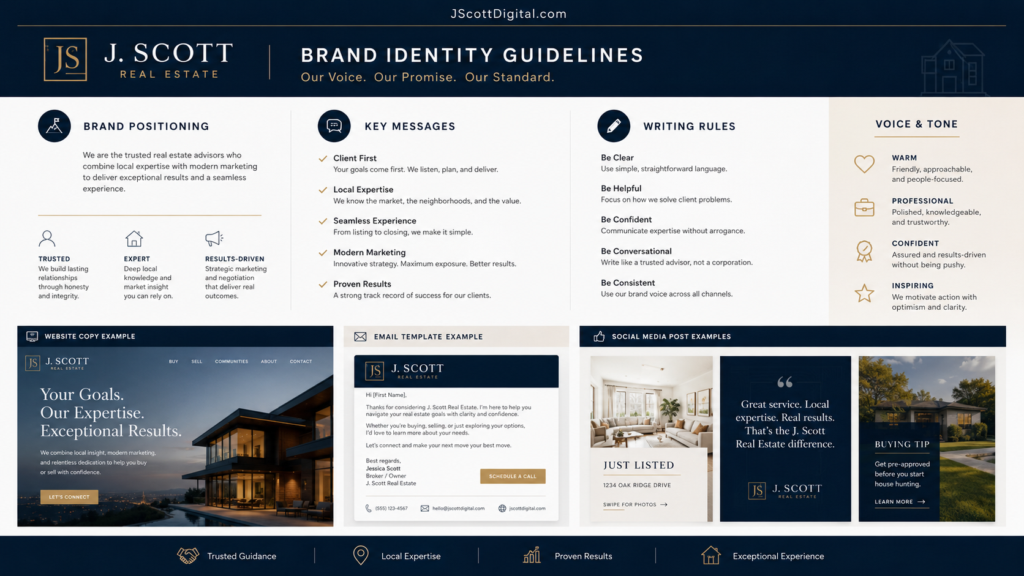
A working brand guide does not need to become a large presentation.
Adobe’s brand style guide recommends documenting elements such as audience, voice, tone, and brand identity so writers, designers, and outside partners can work from the same reference.
For day-to-day real estate content, one page can cover the essentials:
Priority audience — Who the business most wants to reach.
Positioning statement — The position the company wants to occupy.
Core messages — Three or four ideas worth repeating.
Proof points — Evidence supporting those messages.
Voice rules — Specific instructions a writer can apply.
Preferred terminology — Real estate terms the company uses consistently.
Restricted claims — Statements requiring stronger sourcing, context, or approval.
Examples — Short samples showing the desired standard.
The guide should make editing faster. If a writer still has to guess what “credible but energetic” means, the rule needs more precision.
Test the Guide Against Real Work
Apply the draft guide to a homepage section, one newsletter, one social post, a service page, and a campaign email.
Differences will appear quickly. A voice rule that looks clear on paper may still produce inconsistent copy. Revise the guide based on what the test reveals.
Our Real Estate Content & Editorial work brings brand voice, real estate writing, research, and editing into the same publishing process. That combination is useful when several channels or writers need to follow one brand standard without flattening every piece into identical copy.
Review the Brand When the Business Changes
Positioning and messaging should remain stable enough to build recognition, but the business can change. A company may narrow its audience, introduce a new service, leave a market, or discover that its current position no longer reflects why clients choose it.
Review the core positioning, messages, proof, and writing rules together when the business direction changes. That prevents one channel from quietly moving in a new direction while the rest stay behind.
Readers Should Recognize the Same Business
Strong real estate brand messaging does not require identical wording everywhere.
The website can carry more detail. Email can be more personal. Social content can be shorter and more immediate. A proposal can become more technical.
Readers should still recognize the same business.
Define the position first. Decide which messages deserve repetition, turn broad voice adjectives into usable writing rules, and test those rules against real content before distributing them across the organization.