Multi-Channel Real Estate Content Shouldn’t Be Copy and Paste
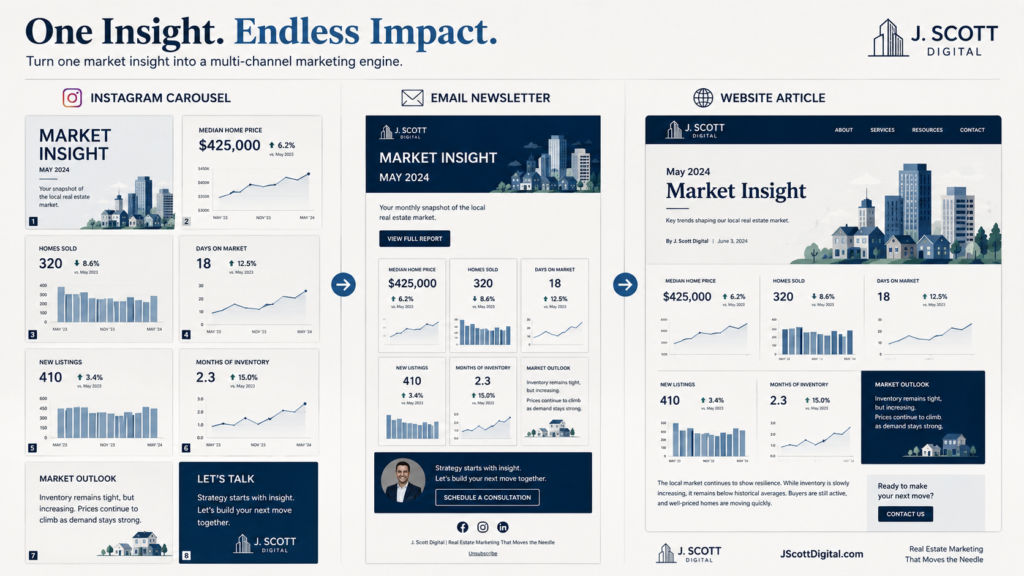
Publishing the same message three times is not a multi-channel strategy.
A real estate insight that works as an Instagram carousel can feel flat in an email newsletter. The newsletter version may be too long for social, while campaign copy can sound too promotional for either one.
Strong multi-channel real estate content starts with one useful idea, then changes the delivery to fit how people use each channel. You keep the facts, positioning, and brand voice consistent while adapting the hook, depth, format, timing, and call to action. Readers get continuity without feeling as if they are seeing the same post everywhere.
Put One Real Estate Idea Through Three Different Jobs
Suppose the core idea is simple:
Rising insurance costs can weaken rental-property performance even when rents and occupancy remain strong.
Before you create anything, separate the message from the format.
The message is what must remain true:
- Insurance costs can materially affect property performance.
- Strong revenue does not eliminate expense risk.
- Investors need to account for insurance when evaluating cash flow.
Everything else can change.
Instagram Has to Win Attention Quickly
On Instagram, the first job is not to explain the entire issue. It is to make the problem easy to recognize.
A carousel might open with:
Your rents went up. Your cash flow still went down.
The next slides could show the sequence:
- Rental income increased.
- Occupancy stayed stable.
- Insurance premiums jumped.
- NOI declined.
- Revenue told only part of the story.
The final slide can direct interested readers toward a more detailed resource.
Instagram best-practices guidance from Meta emphasizes platform-specific thinking around creation, engagement, reach, and content performance. The practical lesson is straightforward: social content should be designed for the way people encounter it, not repurposed mechanically from a longer format.
Email Can Explain the Why
A newsletter reader has made a different commitment.
They chose to subscribe and then chose whether to open the message. That gives you more room to add context, introduce a short example, and explain why the issue deserves attention.
The email might begin:
A rental property can look healthier on the revenue line while becoming weaker underneath. Insurance is a good example. When premiums rise faster than rents, NOI can fall even with stable occupancy.
From there, you can show a brief calculation and link to a deeper article or tool.
Litmus email marketing guidance emphasizes relevance and tailoring content around subscriber needs. That principle fits multi-channel real estate content because the audience’s relationship with the channel should influence how much detail you provide and what you ask them to do next.
A Marketing Campaign Needs Movement
A campaign has a bigger job than either a social post or one newsletter. It needs to move the reader from awareness toward a deeper action.
The same insurance idea could become:
Instagram: Identify the problem.
Newsletter: Explain why it happens.
Website article: Work through the economics.
Checklist or worksheet: Help the reader apply the idea.
Follow-up email: Address a related question.
Relevant resource or service page: Offer the next logical step.
Every asset advances the subject. You are not stretching one piece of copy across six placements.
Decide What Must Stay Fixed Before Anyone Starts Writing
One person writes social. Someone else drafts the newsletter, while another person builds campaign copy. By launch day, all three assets may cover the same topic but sound as if they came from different organizations.
A short message brief prevents that drift.
| Element | Keep consistent | Adapt by channel |
|---|---|---|
| Core idea | Yes | No |
| Facts and evidence | Yes | Presentation only |
| Brand position | Yes | No |
| Hook | No | Yes |
| Length | No | Yes |
| Visual format | No | Yes |
| Level of detail | No | Yes |
| CTA | No | Yes |
| Publishing timing | No | Yes |
Give Each Channel a Different Reader Question
A simple way to prevent duplication is to decide what question each channel should answer.
Using the insurance example:
Instagram: What should get my attention?
Email: Why is this important?
Website article: How does this actually work?
Resource or tool: How do I apply it?
Campaign follow-up: What should I examine next?
Now the content is not merely getting shorter or longer. Each version advances the reader’s understanding.
In real estate, that distinction helps protect technical meaning when a topic is compressed for social. Owned channels can carry the explanation and examples.
Know When an Idea Does Not Belong Everywhere
Multi-channel does not mean every channel.
A detailed comparison of commercial lease structures might work well as an article and newsletter but produce an awkward Instagram post. Meanwhile, a renovation before-and-after sequence may be perfect for social while offering little reason for a standalone email.
Forcing every idea onto every platform creates filler.
Sprout Social’s cross-posting guidance makes a similar distinction: the central message can remain consistent while format, creative, captions, timing, and presentation change to fit each platform.
Start with the idea, then decide where it has a genuine role.
Build a Message Spine Before the Content Calendar
A content calendar tells you when something publishes. It does not tell you whether the assets belong together.
Before assigning formats, write a compact message spine:
Core idea: What is the one point you are trying to establish?
Evidence: Which facts or examples support it?
Audience: Who specifically needs this information?
Position: What should the reader understand after seeing the campaign?
Boundaries: What should the content avoid overstating?
Next step: Where should interested readers go after each channel?
That brief can support an Instagram carousel, email, article, landing page, or sales-support asset without turning them into copies of one another.
Change the CTA as the Reader Gets Closer
Calls to action should not stay identical across the campaign.
Someone seeing the first Instagram post may only need a reason to save the idea or continue to an article. A newsletter subscriber may be ready for a guide, while a reader who has already used a worksheet or reviewed a service page can reasonably see a stronger commercial next step.
| Channel | Reasonable CTA |
|---|---|
| Read, save, or explore | |
| Newsletter | Continue to article or resource |
| Article | Use a tool or related guide |
| Downloadable resource | Apply the idea |
| Campaign follow-up | Explore the relevant service or offer |
A CTA becomes less intrusive when it matches the amount of intent the reader has already shown.
Measure the Job You Assigned to Each Channel
Instagram saves and shares may tell you the idea is relevant. Newsletter clicks can indicate deeper interest, while article engagement may show that readers want more detail. Downloads suggest practical intent, and qualified inquiries may appear later.
Do not expect every piece to produce the final conversion directly. Measure whether each channel did the job you gave it.
If social repeatedly creates interest but newsletter engagement falls, the problem may be the transition rather than the topic.
Make Repetition Feel Like Progress
People rarely absorb a useful idea after seeing it once. That does not justify publishing the same wording over and over.
Effective multi-channel real estate content creates recognition while adding something new at each step. A reader might first see the insurance issue on Instagram, then receive a newsletter explaining the economics, later use a worksheet, and eventually reach a relevant resource or service page.
The subject feels familiar because the message is coherent. Each channel still moves the experience forward because it earns its place.
That is the standard to aim for: one strong idea, several distinct executions, and no channel asking the reader to consume the same thing twice.